
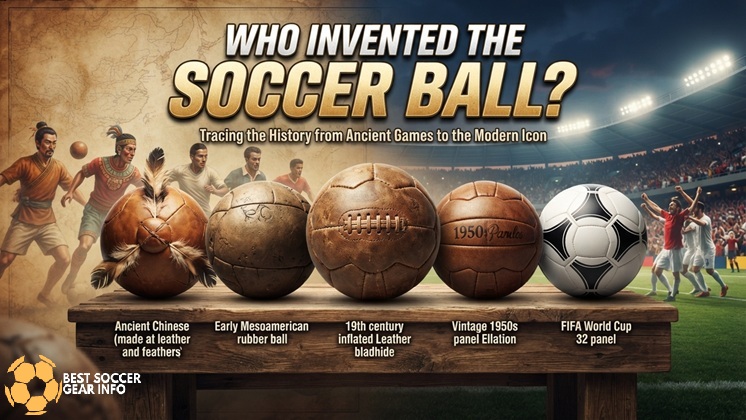
If you are looking for one person who invented the soccer ball, there is no single inventor. The soccer ball developed gradually over centuries from simple inflated animal bladders and leather coverings into the standardized, spherical ball used today.
Charles Goodyear is often associated with the history of the soccer ball because his development and patenting of vulcanized rubber made more durable rubber products possible. However, he did not invent the soccer ball itself.
The modern best soccer ball is the result of contributions from many people, manufacturers, sporting organizations, and technological developments. The Football Association’s rules in England helped standardize the game in the 1860s, while later innovations in ball construction, materials, panel designs, and manufacturing transformed the ball.
Who Invented the Soccer Ball?
No single person invented the soccer ball.
Early forms of football were played with objects that could be kicked, including inflated animal bladders covered with leather. As football became organized during the 19th century, manufacturers developed better ways to make balls rounder, stronger, easier to inflate, and more consistent.
Several historical figures are particularly important:
| Person or organization | Contribution |
| Charles Goodyear | Developed vulcanized rubber, which helped make durable rubber products possible |
| Richard Lindon | Associated with the development of an India-rubber bladder for footballs in the 19th century |
| The Football Association | Helped standardize association football through formal rules beginning in 1863 |
| Adidas and later ball designers | Introduced major advances in panel construction, materials, surface technology, and visibility |
So, if the question is “Who created the soccer ball?”, the most accurate answer is that the soccer ball evolved rather than being invented by one individual.
Who Invented the First Soccer Ball?
There is no reliably documented individual who can be identified as the inventor of the first soccer ball ever made.
Long before modern soccer was formally organized, people played various forms of ball games using relatively simple balls. Inflated animal bladders were among the materials used for early footballs, with leather coverings helping protect the bladder.
The important distinction is that the first ball used for a football-type game is not necessarily the same thing as the first standardized soccer ball.
Association football was formally organized in England in the 19th century. The Football Association was founded on October 26, 1863, and its members established a written set of rules for the game.
That standardization created the environment in which the soccer ball could also become more standardized.
When Was the First Soccer Ball Invented?
There is no universally accepted invention date for the first soccer ball.
Instead, its development happened in stages:
- Early ball games: People used natural materials and animal bladders to create balls.
- Leather footballs: Leather coverings became important for protecting inflated bladders.
- 19th-century improvements: Rubber technology and improved bladder designs made balls more practical.
- 1860s onward: Organized association football created greater demand for consistent balls.
- 20th century: Manufacturers improved stitching, panel construction, shape, and water resistance.
- Late 20th and 21st centuries: Synthetic materials, bonded panels, and advanced surface technologies transformed soccer-ball construction.
Therefore, giving a single year such as 1863 as the invention date of the soccer ball would be misleading. 1863 is the year The Football Association was founded and the rules of association football were formalized—not the year the soccer ball itself was invented.
What Was the First Soccer Ball Made Of?
Early footballs were generally constructed around an inflatable animal bladder, often protected by a leather outer covering.
Before modern rubber and synthetic materials, the bladder was a major limitation. A ball needed to retain air while also being strong enough to withstand repeated kicking.
Leather became the traditional outer material for footballs for many decades. Historical World Cup balls, for example, were predominantly leather before synthetic materials became common. FIFA’s history of World Cup balls describes the evolution from early leather balls to increasingly advanced designs.
Early soccer-ball construction
A simplified early construction looked like this:
Inflated bladder → leather covering → stitched football
The result was functional, but it was considerably different from today’s highly engineered soccer balls.
Charles Goodyear and the Soccer Ball
Did Charles Goodyear invent the soccer ball?
No.
Charles Goodyear was an American inventor associated with the development of vulcanized rubber. The Smithsonian records his 1844 patent relating to rubber and describes how his process transformed rubber into a more stable and useful commercial material.
This technology became important to many products, including sporting equipment.
Goodyear’s contribution is therefore best understood as an important development in rubber technology, rather than the invention of the soccer ball.
Why is Charles Goodyear associated with soccer balls?
Because rubber technology solved problems that affected the construction of inflatable balls.
A useful distinction is:
Goodyear → rubber technology
Football manufacturers → ball construction
Football organizations → rules and standardization
These developments eventually came together to produce the soccer balls used today.
Richard Lindon and the Development of the Football Bladder
Richard Lindon, a 19th-century English boot and football maker, is frequently associated with an important improvement in football construction.
Historical accounts credit Lindon with developing an India-rubber bladder as an alternative to animal bladders around the 1860s. He also developed equipment for inflating the bladder.
This was significant because an inflatable rubber bladder could provide a more practical and consistent way to construct a football.
However, Lindon should not be described as the sole inventor of the soccer ball. His contribution was specifically related to football-bladder technology and manufacturing, part of a much longer evolution.
How Did the Soccer Ball Develop?
The history of the soccer ball can be understood as a progression in materials and construction.
| Period | Major development | Typical characteristics |
| Early football games | Animal bladders | Irregular shape and limited durability |
| 19th century | Leather-covered balls | Stronger exterior and better shape |
| Mid-to-late 19th century | Improved rubber bladders | Better inflation and consistency |
| Early 20th century | Improved leather construction | More standardized footballs |
| Mid-20th century | Improved panel designs | More consistent spherical shapes |
| 1970s | Iconic 32-panel designs | Improved visibility and recognizable geometry |
| 1980s onward | Synthetic materials | Better water resistance and durability |
| 2000s onward | Thermally bonded construction | Fewer panels and increasingly engineered surfaces |
| Modern era | Advanced synthetic construction | Specialized aerodynamics, texture, and consistency |
This evolution is why it is more accurate to talk about the invention and development of the soccer ball rather than identifying one inventor.
Who Invented the Modern Soccer Ball?
There is also no single inventor of the modern soccer ball.
The modern ball emerged from numerous technological improvements.
One major milestone was the Adidas Telstar, introduced for the 1970 FIFA World Cup in Mexico. FIFA describes the Telstar as a 32-panel leather ball and notes that its black-and-white design was intended to improve visibility on television.
Adidas itself identifies the Telstar as its first FIFA World Cup match ball and explains that its 12 black pentagons and 20 white hexagons were designed to stand out on black-and-white television broadcasts.
But the Telstar was not the invention of the soccer ball. It was a major step in the evolution of soccer-ball design.
Who Designed the Telstar Soccer Ball?
The Adidas Telstar was designed for the 1970 World Cup and became one of the most recognizable soccer-ball designs ever produced.
It contained:
- 32 panels
- 12 black pentagons
- 20 white hexagons
- A leather construction
- A black-and-white visual pattern
The design became strongly associated with the appearance of a traditional soccer ball. FIFA notes that the Telstar represented a major stage in the continuing evolution of football design.
Who Invented the White Soccer Ball?
There is no single inventor of the white soccer ball.
White and light-colored footballs existed before the famous Telstar design. What made the Telstar particularly important was not simply that it was white—it introduced the highly recognizable white-and-black panel pattern to the World Cup in 1970.
The black panels had an important practical purpose: they helped the ball stand out on black-and-white television broadcasts.
So:
Who invented the white soccer ball?
There is no established single inventor.
Who made the famous black-and-white soccer-ball design?
The Adidas Telstar of 1970 popularized that appearance worldwide.
Why Are Soccer Balls Black and White?
The famous black-and-white soccer ball became especially recognizable because of the 1970 Adidas Telstar.
At the time, black-and-white television was still widely used. The contrasting black and white panels made the ball easier to see on television screens.
The original Telstar had 12 black pentagons and 20 white hexagons, creating its distinctive 32-panel appearance.
The design became so influential that the traditional black-and-white soccer ball became a visual symbol of the sport.
Modern soccer balls, however, can use almost any combination of colors and graphics.
Were the First Soccer Balls Round?
Not necessarily.
Early balls were much less consistent in shape than modern soccer balls. The shape depended heavily on the bladder, the leather covering, stitching, and inflation.
Improvements in bladder construction and panel geometry gradually made footballs more spherical.
By the 20th century, manufacturers were increasingly focused on creating balls that were:
- More spherical
- More consistent
- More durable
- Easier to control
- More resistant to water
- More predictable in flight
This eventually led to the highly engineered spherical balls used today.
How Soccer Ball Design Changed Over Time
Leather soccer balls
Leather dominated football construction for much of the sport’s early history.
Leather was durable, but it had an important disadvantage: water could make the ball heavier and affect its performance.
Manufacturers therefore looked for ways to improve water resistance.
The 32-panel era
The 32-panel construction became one of the most recognizable formats in soccer-ball history.
The Telstar’s 12 black pentagons and 20 white hexagons created a distinctive spherical appearance that influenced how people imagined a soccer ball for decades.
Synthetic soccer balls
Synthetic materials eventually replaced traditional leather in high-level ball construction.
Adidas’ history of World Cup balls identifies the 1986 Azteca as the first World Cup match ball made from synthetic materials.
Synthetic construction helped reduce problems associated with water absorption and allowed manufacturers greater control over the ball’s properties.
Thermally bonded soccer balls
Later designs moved beyond traditional stitched panels.
The 2006 +Teamgeist used 14 thermally bonded panels rather than the traditional 32 stitched-panel construction, representing another major change in ball manufacturing.
Modern soccer balls can therefore look very different from the leather balls used in the early history of the sport.
When Did Soccer Balls Become Standardized?
Soccer-ball standardization developed gradually rather than happening on one specific date.
The Football Association was formed in England in 1863, with the purpose of establishing a definite code of rules for football. Its first laws were finalized in December of that year.
The organization of the sport created a greater need for equipment that could be used consistently.
Modern Law 2 also specifies requirements for match balls, including spherical shape, circumference, weight, and pressure.
For example, the current official specifications cover characteristics such as:
- Spherical shape
- Approved construction materials
- Circumference
- Weight
- Inflation pressure
These standards are very different from the relatively variable balls used during football’s early development.
How Big Is a Modern Soccer Ball?
Today’s standard adult match ball is commonly referred to as Size 5.
Modern match-ball regulations specify a circumference of approximately 68–70 cm (27–28 inches) and a starting weight of approximately 410–450 g (14–16 oz).
The exact ball size used in soccer depends on the age group and competition.
For a complete breakdown of soccer-ball sizes by age, see our guide to soccer ball sizes.
Soccer Ball History Timeline
| Year/period | Development |
| Ancient and medieval periods | Various ball games used natural materials and animal bladders |
| 19th century | Leather-covered footballs became increasingly common |
| 1840s | Charles Goodyear’s rubber technology advanced the use of vulcanized rubber |
| Around the 1860s | Rubber-bladder technology became an important football development |
| 1863 | The Football Association was founded and association football rules were formalized |
| Early 1900s | Football construction continued to become more standardized |
| 1930 | First FIFA World Cup; host nations supplied match balls |
| 1950s–1960s | Panel construction and ball designs continued evolving |
| 1970 | Adidas Telstar became the first Adidas World Cup match ball |
| 1970s–1980s | Water-resistant coatings and synthetic materials changed ball construction |
| 2000s | Thermally bonded and reduced-panel designs became prominent |
| Today | Advanced synthetic materials, panel engineering, textures, and aerodynamic designs are used |
FIFA notes that the early World Cups did not have a single permanent ball supplier; at the inaugural 1930 World Cup, different balls were even used in the final because the teams wanted their own preferred ball. Adidas became the official World Cup ball supplier beginning with Mexico 1970.
Common Misconceptions About the Soccer Ball
Charles Goodyear invented the soccer ball
False. Goodyear’s important contribution was vulcanized rubber technology, not the invention of soccer itself or the modern soccer ball.
The soccer ball was invented in 1863
Not exactly. 1863 marks the founding of The Football Association and the formalization of association-football rules. The ball itself had already existed in various forms.
Adidas invented the soccer ball
False. Adidas played a major role in the evolution of modern World Cup balls, beginning with the Telstar in 1970, but soccer balls existed long before Adidas entered the market.
The Telstar was the first soccer ball
False. The Telstar was an important World Cup ball and the first Adidas World Cup match ball, but footballs had been used for many decades before it.
The first soccer balls were black and white
Not necessarily. Early footballs were commonly leather-colored or brownish. The iconic black-and-white appearance became especially famous after the 1970 Telstar.
Frequently Asked Questions
No single person invented the soccer ball. It evolved from earlier balls made with materials such as animal bladders and leather, followed by improvements in rubber technology, bladder construction, panel design, and synthetic materials.
The inventor of the first soccer ball is unknown. There is no reliable historical evidence identifying one person as its inventor.
No. Charles Goodyear developed vulcanized rubber technology, which became important to many products. He did not invent the soccer ball itself.
There is no universally accepted invention date. Football balls existed before association football was formally organized in 1863, and the modern soccer ball developed gradually over many years.
Early footballs were generally made around an inflated animal bladder with a leather covering. Later developments introduced improved rubber bladders and increasingly sophisticated leather and synthetic constructions.
No single person invented it. The modern soccer ball is the result of many developments in bladder technology, leather and synthetic materials, panel geometry, stitching, bonding, and manufacturing.
There is no established single inventor of the white soccer ball. White footballs existed before the famous black-and-white Telstar. The 1970 Telstar helped popularize the iconic white ball with black panels.
The contrasting pattern helped make the ball easier to see on black-and-white television. The 1970 Adidas Telstar became particularly famous for this design.
Adidas supplied its first official FIFA World Cup match ball for the 1970 World Cup in Mexico, with the Telstar. Adidas has continued supplying official World Cup match balls since then.
The original 1970 Telstar was made of leather and consisted of 32 hand-stitched panels: 12 black pentagons and 20 white hexagons.
They progressed from relatively simple bladder-and-leather constructions to increasingly spherical, standardized, water-resistant, synthetic, and technologically engineered balls. Modern balls can use thermally bonded panels and specialized surface textures rather than traditional leather stitching.
Conclusion
The answer to “Who invented the soccer ball?” is not a single name.
The soccer ball was developed over a long period of time. Early footballs used animal bladders and leather. Improvements in rubber technology, including Charles Goodyear’s work with vulcanized rubber, helped expand the possibilities for sporting equipment. Football makers subsequently improved bladder and panel construction, while organizations such as The Football Association standardized the game.
The biggest visual turning point came much later with the 1970 Adidas Telstar, whose 32-panel black-and-white design became one of the most recognizable soccer-ball patterns in history.
So rather than asking who invented the soccer ball, it is more accurate to ask how the soccer ball evolved—from simple leather-covered bladders to the highly engineered match balls used today.