A modern soccer ball is usually made from synthetic materials rather than natural leather. The main materials are typically polyurethane (PU) or thermoplastic polyurethane (TPU) for the outer cover, rubber for the bladder, polyester or nylon for the internal carcass, and adhesive or bonding materials used to join the panels. The exact combination varies by ball, price level, and construction method.
For example, the 2026 adidas FIFA World Cup Trionda competition ball uses a surface made from 60% polyurethane and 40% recycled polyester, while a Trionda club ball uses a thermoplastic polyurethane cover and a butyl bladder.
What Materials Are Used to Make a Soccer Ball?
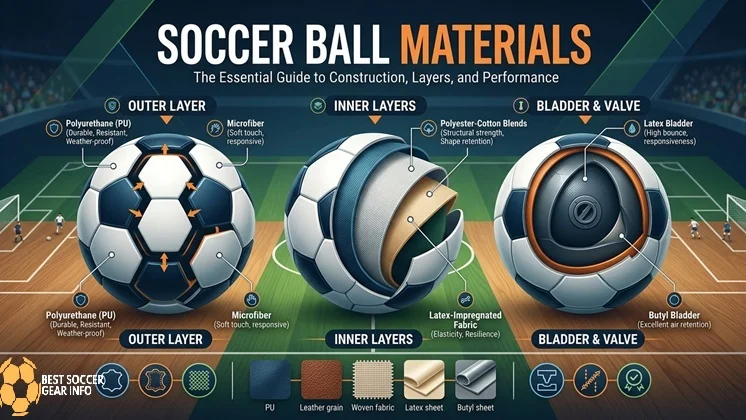
A soccer ball is not made from one material. It is a layered product in which different materials perform different jobs.
| Soccer ball component | Common material | Main purpose |
| Outer cover | Polyurethane (PU) or TPU | Touch, durability and water resistance |
| Backing/carcase layers | Polyester, nylon or similar textile | Strength, shape retention and structure |
| Bladder | Butyl or latex rubber | Holds the air |
| Panels | Synthetic leather or synthetic polymer material | Forms the outside surface |
| Seams/bonding | Thread, adhesive or thermal bonding | Joins the panels |
| Surface texture | Molded or embossed polymer | Helps control touch and ball flight |
FIFA explains that almost every football manufactured today uses synthetic leather, together with a latex or butyl bladder and additional layers, often with a waterproof coating. The panels can then be stitched or joined using other manufacturing methods.
The Main Soccer Ball Materials
1. Polyurethane (PU)
Polyurethane is one of the most common materials used for modern soccer ball covers.
PU can provide a relatively soft touch while also allowing manufacturers to create textured surfaces. Depending on the construction, the surface can be designed for characteristics such as ball control, durability and resistance to water absorption.
Many higher-level soccer balls use polyurethane-based outer surfaces.
A useful distinction is that PU is the material family, while the particular formulation, thickness, texture and backing layers can differ considerably between balls.
2. Thermoplastic Polyurethane (TPU)
Thermoplastic polyurethane, or TPU, is another important modern soccer ball material.
TPU is a type of polyurethane that can be processed as a thermoplastic material. It is used for the covers of many recreational, training and match-oriented balls.
For example, adidas lists the cover of its 2026 Trionda Club Ball as 100% thermoplastic polyurethane, with a butyl bladder.
The FIFA Official Store similarly lists the Trionda Mexico Home Club Ball as using a 100% recycled TPU cover.
3. Polyester
Polyester is commonly found in the internal layers of a soccer ball and can also form part of the outer material.
The internal textile layers help give the ball structure and contribute to its shape and feel.
The 2026 adidas Trionda competition ball, for example, is listed as 60% polyurethane and 40% recycled polyester for its surface construction.
4. Nylon
Nylon can be used as an internal winding or reinforcement material.
Its purpose is different from the outer cover. Rather than being the part that players normally touch, the internal carcass helps provide structural support.
The FIFA Official Store describes the Trionda Mexico Home Club Ball as having a nylon-wound carcass, together with a TPU surface and butyl bladder.
5. Rubber
Rubber is especially important because the bladder holds the air inside the soccer ball.
Two commonly used bladder materials are:
- Butyl rubber
- Latex rubber
FIFA identifies latex and butyl as common bladder materials in football manufacturing.
Butyl bladder
Butyl bladders are commonly used when manufacturers want good air retention.
For example, adidas lists a butyl bladder on its Trionda Club Ball, while the FIFA Official Store describes the same type of bladder as providing air retention.
Latex bladder
Latex is another traditional bladder material used in soccer balls.
A latex bladder can provide a different playing feel from a butyl bladder, and latex is commonly associated with higher-end or performance-oriented balls. However, the exact characteristics depend on the complete construction of the ball rather than the bladder material alone.
What Is the Difference Between PU, TPU and PVC Soccer Balls?
These materials are often confused because they can all appear in descriptions of synthetic soccer balls.
| Material | What it is | Typical role |
| PU | Polyurethane | Soft synthetic cover material |
| TPU | Thermoplastic polyurethane | Synthetic cover material with thermoplastic properties |
| PVC | Polyvinyl chloride | Commonly used in some lower-cost synthetic covers |
| Rubber | Elastomer | Mainly used for the bladder |
| Polyester | Synthetic fiber/polymer | Reinforcement and structural layers |
| Nylon | Synthetic polymer fiber | Carcass reinforcement/winding |
The material name alone does not determine whether a soccer ball is good or bad. Panel construction, thickness, backing layers, bladder type, manufacturing process and quality control also affect performance.
What Is the Inside of a Soccer Ball Made Of?
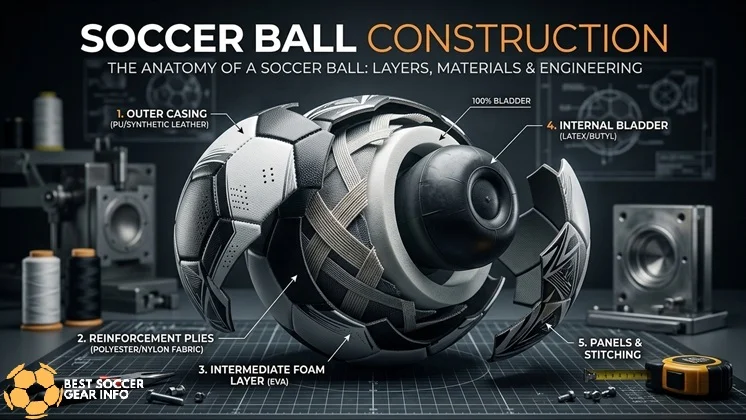
A soccer ball has several layers rather than simply an outer shell and an air-filled center.
A simplified cross-section looks like this:
Outer surface → cover → backing layers → textile carcass → bladder → air
The outer cover provides the surface that contacts the player’s foot. Beneath it, additional layers provide strength and help maintain the ball’s shape. The bladder contains the air.
FIFA describes modern footballs as having synthetic leather, a latex or butyl bladder and additional layers beneath a waterproof coating.
What is the bladder made of?
The bladder is commonly made from butyl rubber or latex rubber.
Its primary function is to hold the compressed air inside the ball.
What is the carcass made of?
The carcass can contain textile materials such as polyester or nylon. These layers provide structural reinforcement around the bladder.
What are soccer ball panels made of?
Modern panels are generally made from synthetic materials, particularly polyurethane-based materials. The panels may then be stitched, glued, or thermally bonded, depending on the ball’s construction.
Different Soccer Ball Materials by Construction
The materials and manufacturing process work together.
Hand-stitched soccer balls
Hand-stitched balls have panels joined with stitching.
FIFA notes that hand-stitched balls have deep, strong seams and that this construction can contribute to durability.
Machine-stitched soccer balls
Machine stitching is commonly used for recreational and competitively priced balls.
The 2026 adidas Trionda Club Ball, for example, uses a machine-stitched construction.
Hybrid soccer balls
Hybrid construction combines stitching with adhesive bonding.
This allows manufacturers to use stitching while also bonding panels or construction layers together.
Thermally bonded soccer balls
Thermal bonding joins the panels using heat and pressure rather than conventional exposed stitching.
FIFA says thermal bonding has been used for every FIFA World Cup ball produced since 2006. The technique can also help create a more seamless surface and improve water resistance.
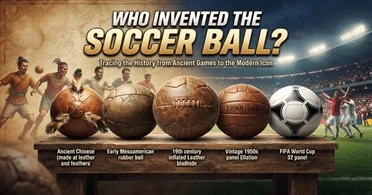
Modern Soccer Ball Materials vs. Older Leather Balls
The materials used in soccer balls have changed considerably over time.
Older footballs were made from natural leather, but leather had limitations when exposed to water. It could absorb moisture and become heavier.
Modern balls primarily use synthetic materials. FIFA notes that synthetic leather is now used in almost every football manufactured today because its thickness varies much less than real leather.
Historical progression
A simplified history looks like this:
Natural leather → improved leather constructions → synthetic leather → polyurethane-based synthetic covers → advanced TPU/PU surfaces and layered constructions
Modern synthetic materials allow manufacturers to control surface texture, thickness, shape and water resistance more consistently.
What Materials Does adidas Use in Soccer Balls?
adidas uses different materials depending on the soccer ball model.
For example, the 2026 adidas Trionda competition ball is listed as having a surface construction of 60% polyurethane and 40% recycled polyester. It also uses thermal bonding and a textured surface.
The adidas Trionda Club Ball, meanwhile, is listed with:
- 100% thermoplastic polyurethane cover
- Butyl bladder
- Machine-stitched construction
This illustrates an important point: there is no single “adidas soccer ball material.” Different adidas balls use different combinations depending on their intended level and construction.
Why Are Soccer Balls Made From Synthetic Materials?
Synthetic materials allow manufacturers to produce balls with more consistent characteristics.
Important advantages include:
- Consistent thickness
- Better control over surface texture
- Resistance to water absorption
- Consistent shape
- Durable outer surfaces
- Different touch characteristics
- Compatibility with stitching and thermal bonding
FIFA’s football testing program evaluates characteristics including weight, circumference, roundness, bounce, water absorption, pressure loss, and shape and size retention.
This shows why the material is only one part of soccer-ball performance.
Does Soccer Ball Material Affect Touch?
Yes. The outer material and its texture can influence how the ball feels when it contacts the foot.
A softer synthetic cover can provide a different touch from a harder or more heavily textured surface. The underlying foam, backing layers, bladder and construction also contribute to the overall feel.
Therefore, it is not accurate to say that PU automatically feels better than TPU, or that one material automatically makes a ball superior.
The complete construction matters.
Does Soccer Ball Material Affect Durability?
Yes, but material is only one factor.
Durability depends on:
- Cover material
- Cover thickness
- Backing layers
- Stitching or bonding
- Bladder construction
- Playing surface
- Frequency of use
- Storage and maintenance
A durable cover can still wear quickly if a soccer ball is repeatedly used on a surface for which it was not designed.
Does Soccer Ball Material Affect Water Resistance?
It can.
Water absorption is particularly important because excessive moisture can change the ball’s characteristics.
Modern synthetic covers and bonded constructions can be designed to reduce water absorption. FIFA specifically includes water absorption in its football testing requirements.
Thermal bonding can also reduce exposed seams compared with traditional stitched construction.
Which Soccer Ball Material Is Best?
There is no single material that is best for every player.
Instead, consider the purpose of the ball:
| Use | What to look for |
| Professional match | High-quality PU/TPU construction and appropriate certification |
| Club competition | Durable synthetic cover and reliable bladder |
| Training | Durable cover and construction suited to frequent use |
| Recreational play | Affordable synthetic cover and good air retention |
| Wet conditions | Water-resistant construction |
| Hard outdoor surfaces | Durable cover designed for that playing environment |
For regulated competition, the FIFA Quality mark is more meaningful than simply looking at whether a ball says PU or TPU on the packaging. FIFA’s certification program tests balls for characteristics including weight, circumference, roundness, bounce, water absorption, pressure loss and shape/size retention.
What Materials Are Used to Make an Improvised Soccer Ball?
An improvised soccer ball is a homemade substitute made from locally available materials rather than a manufactured regulation soccer ball.
Common examples can include:
- Paper
- Cloth
- Plastic bags
- String or tape to hold the material together
The exact materials depend on what is available.
An improvised ball should not be expected to have the same spherical shape, weight, bounce, durability or safety characteristics as a manufactured soccer ball.
What is making a soccer ball from locally available materials called?
Making a soccer ball from locally available materials is generally described as making an improvised or homemade soccer ball.
There is not one universal technical name for every homemade-ball construction.
Name three materials used when improvising a soccer ball
Three commonly available materials are:
- Paper
- Cloth
- Plastic bags
These can be combined to create a temporary ball-like object for informal play.
Raw Materials of a Soccer Ball
The term “raw materials” can refer to the materials used to manufacture the different components rather than one single substance.
The major material categories include:
Synthetic polymers
- Polyurethane
- Thermoplastic polyurethane
- PVC in some ball constructions
Textile materials
- Polyester
- Nylon
Rubber
- Butyl
- Latex
Manufacturing materials
- Thread
- Adhesives
- Bonding materials
- Printing/coating materials
The exact recipe differs between manufacturers and individual models.
Are Soccer Balls Made of Leather?
Most modern soccer balls are not made from natural leather.
Modern football manufacturing primarily uses synthetic leather and synthetic polymer materials. FIFA specifically states that almost every football manufactured today is made from synthetic leather, noting its more consistent thickness compared with real leather.
Leather is therefore more important when discussing the history of soccer ball materials than the construction of most modern soccer balls.
Are Soccer Balls Made of Plastic?
Some of the materials used in modern soccer balls are polymers commonly described in everyday language as plastics.
For example, polyurethane and thermoplastic polyurethane (TPU) are synthetic polymer materials used in soccer-ball covers.
However, saying simply that a soccer ball is “made of plastic” leaves out important components such as the rubber bladder and textile reinforcement layers.
Soccer Ball Materials: Quick Comparison
| Material | Main location | Main function |
| PU | Outer cover | Touch, surface performance and durability |
| TPU | Outer cover | Synthetic cover construction |
| PVC | Outer cover on some balls | Cost-effective synthetic cover |
| Polyester | Internal/cover construction | Reinforcement and structure |
| Nylon | Carcass/winding | Structural support |
| Butyl rubber | Bladder | Air retention |
| Latex rubber | Bladder | Air-filled core |
| Natural leather | Older/historical balls | Traditional outer covering |
Frequently Asked Questions
Synthetic materials are standard in modern soccer-ball manufacturing. Polyurethane and thermoplastic polyurethane are common cover materials, while butyl or latex rubber is used for the bladder.
Professional balls commonly use a synthetic polyurethane-based outer construction with internal textile layers and a rubber bladder. Exact materials vary by model.
For example, the 2026 adidas Trionda competition ball uses polyurethane and recycled polyester in its surface construction.
They can be made with either. PU and TPU are both used in modern soccer-ball covers, and some manufacturers specify TPU for particular models.
Inside the outer panels are structural layers and a bladder. The bladder is commonly made from butyl or latex rubber and contains the air.
The cover is the outside surface that players touch and kick. The bladder is the internal air-containing component.
Synthetic materials offer manufacturers more consistent thickness and better control over characteristics such as water resistance and surface construction. FIFA says synthetic leather is now used in almost every football manufactured today.
It depends on the model. Current adidas examples include polyurethane, thermoplastic polyurethane, recycled polyester, nylon and butyl rubber, depending on the ball.
Not necessarily. Price can reflect the entire construction, manufacturing process, certification, design and quality control—not simply the name of the outer material.
Look beyond the material name. Consider the ball’s intended use, construction method, bladder, durability, surface, playing environment and certification.
For match-quality balls, FIFA certification provides independently tested performance requirements rather than relying only on a manufacturer’s material description.
Final Takeaway
Modern soccer balls are multi-layered products made from several materials, not simply a single type of plastic or leather.
The most important materials are PU or TPU for the outer cover, polyester or nylon for structural reinforcement, and butyl or latex rubber for the bladder. Manufacturing methods such as hand stitching, machine stitching, hybrid construction and thermal bonding also affect the finished ball.
When comparing soccer balls, therefore, don’t judge the ball solely by whether it says PU, TPU, PVC, latex, or butyl. The complete combination of materials, construction and intended use determines how the ball performs.