
A standard size 5 soccer ball weighs 410–450 grams (14–16 ounces), or about 0.41–0.45 kg (0.90–0.99 pounds), at the start of a match. This is the weight range specified by the International Football Association Board (IFAB) for the ball used under the Laws of the Game. A regulation size 5 ball also has a circumference of 68–70 cm (27–28 inches).
Smaller soccer balls weigh less. A typical size 4 soccer ball weighs 350–390 grams, while a typical size 3 weighs about 300–320 grams.
Soccer Ball Weight Chart
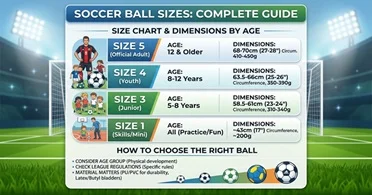
| Ball Size | Typical Circumference | Typical Weight | Weight in kg | Weight in pounds | Common Use |
| Size 1 | 18–20 in (46–51 cm) | Varies by model | Varies | Varies | Skills, mini ball |
| Size 3 | 23–24 in (58–61 cm) | 300–320 g | 0.30–0.32 kg | 0.66–0.71 lb | Younger players |
| Size 4 | 25–26 in (63.5–66 cm) | 350–390 g | 0.35–0.39 kg | 0.77–0.86 lb | Youth soccer |
| Size 5 | 27–28 in (68–70 cm) | 410–450 g | 0.41–0.45 kg | 0.90–0.99 lb | Adult and official soccer |
Size recommendations vary somewhat by league and manufacturer, so age should not be treated as the only factor when choosing a ball. For example, Nike lists size 3 for players under 8, size 4 for ages 8–12, and size 5 for ages 13 and older.
How Much Does a Soccer Ball Weigh?
The answer depends mainly on the size and construction of the ball.
For a regulation adult soccer ball, the answer is 410–450 grams. Converted into other units:
- 410 g = 0.41 kg = 0.90 lb = 14.46 oz
- 450 g = 0.45 kg = 0.99 lb = 15.87 oz
- The official rounded range is commonly expressed as 14–16 ounces.
The rule specifies the weight at the start of the match, which matters because the ball can gain or lose a small amount of weight during use, particularly if its condition changes.
What Is the Weight of a Size 5 Soccer Ball?
A regulation size 5 soccer ball weighs 410–450 grams at the start of a match.
That equals approximately:
| Unit | Size 5 soccer ball weight |
| Grams | 410–450 g |
| Kilograms | 0.41–0.45 kg |
| Pounds | 0.90–0.99 lb |
| Ounces | 14–16 oz |
The size 5 specification also calls for a circumference of 68–70 cm (27–28 inches). These are the measurements specified in Law 2 of the Laws of the Game.
How Much Does a Soccer Ball Weigh in KG?
A standard size 5 soccer ball weighs 0.41–0.45 kg.
If you see a soccer ball advertised as weighing around 0.42 kg or 0.43 kg, it falls within the normal range for a regulation size 5 ball.
Remember that kilograms and grams describe the same measurement:
1 kg = 1,000 g
So:
- 410 g = 0.410 kg
- 420 g = 0.420 kg
- 430 g = 0.430 kg
- 440 g = 0.440 kg
- 450 g = 0.450 kg
How Much Does a Soccer Ball Weigh in Grams?
A regulation size 5 soccer ball weighs 410–450 grams.
This is the most useful unit when comparing a ball’s weight with an official specification because soccer-ball standards are commonly stated in grams.
A ball does not have to weigh exactly 430 grams to be regulation. Any weight from 410 through 450 grams at the start of the match falls within the IFAB range.
How Much Does a Soccer Ball Weigh in Pounds?
A regulation size 5 soccer ball weighs approximately 0.90–0.99 pounds.
The conversion is:
410 g ≈ 0.90 lb
450 g ≈ 0.99 lb
This is why the official range is often simplified to approximately 0.9–1.0 pound.
How Much Does a Size 4 Soccer Ball Weigh?
A standard size 4 soccer ball generally weighs 350–390 grams, or 0.35–0.39 kg.
That is approximately 0.77–0.86 pounds.
Size 4 balls normally have a circumference of about 63.5–66 cm (25–26 inches). Nike categorizes size 4 as a youth ball for ages 8–12.
A size 4 is therefore lighter and smaller than a size 5, making it a common choice for youth players before moving to the full-size ball.
Size 3 vs. Size 4 vs. Size 5 Weight
The progression is straightforward:
| Size | Weight | Approx. pounds | Typical category |
| Size 3 | 300–320 g | 0.66–0.71 lb | Junior |
| Size 4 | 350–390 g | 0.77–0.86 lb | Youth |
| Size 5 | 410–450 g | 0.90–0.99 lb | Adult/full size |
The difference is not simply about circumference. The smaller balls also have lower weight ranges, which changes how they feel when kicking, passing, dribbling and receiving.
Does Soccer Ball Weight Depend on Size?
Yes. Ball size and weight are closely related.
A larger ball generally requires more material and has a larger internal volume, so the standard weight increases as ball size increases.
However, size alone does not determine the exact weight of every ball. Manufacturers also produce specialized lightweight balls for training and youth development. For example, Select lists lightweight versions of some balls below the normal weight range.
This is why it is better to check the manufacturer’s specification instead of assuming that every ball with the same size label weighs exactly the same.
Does Soccer Ball Weight Affect How It Plays?
Yes. Weight is one factor affecting how a soccer ball behaves.
A heavier ball generally requires more force to accelerate than a lighter ball. Weight also interacts with other characteristics such as:
- Ball size
- Inflation pressure
- Cover material
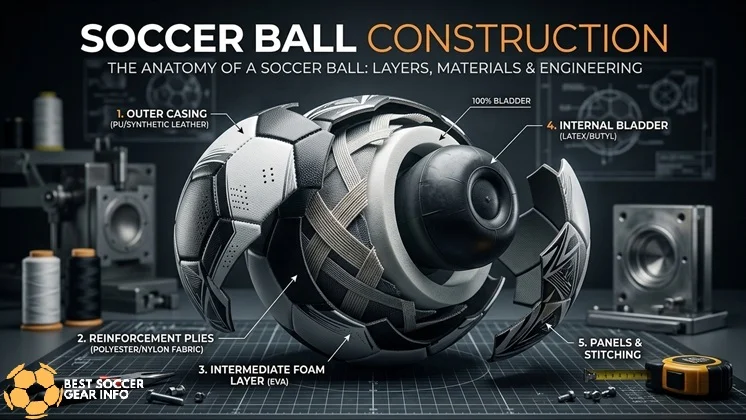
- Bladder construction
- Panel construction
- Surface texture
- Weather and playing conditions
The Laws of the Game specify not only weight and circumference but also the permitted inflation pressure. For a regulation match ball, IFAB specifies 0.6–1.1 atmospheres at sea level, equivalent to approximately 8.5–15.6 psi.
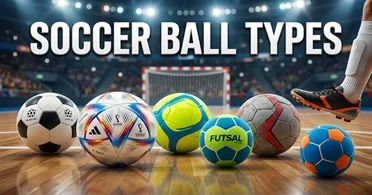
Therefore, two balls with the same nominal size and similar weight can still feel different because their construction and inflation differ. For more details see Soccer Ball Types.
Soccer Ball Weight and Inflation Pressure
Weight should not be confused with inflation pressure.
Weight tells you how heavy the ball is.
Pressure tells you how much air pressure is inside the ball.
For official play, IFAB specifies a pressure of 0.6–1.1 atmospheres at sea level, or approximately 8.5–15.6 psi.
Inflation can affect how a ball feels and behaves, but it does not mean that you should select a ball based on pressure instead of its required size and weight.
For a regulation match, the ball must satisfy the applicable specifications rather than simply being inflated until it “feels right.”
Is a Size 5 Soccer Ball Always 410–450 Grams?
Not necessarily.
The 410–450 g range is the regulation specification for the match ball described by Law 2. Recreational, training, youth-development and lightweight products can have different specifications.
For example, Select lists standard size 5 balls at 410–450 g and some lightweight versions at 350–380 g.
So when buying a soccer ball, distinguish between:
- Regulation match specification
- Training ball
- Lightweight training ball
- Youth ball
- Special-purpose ball
A product being labeled “size 5” does not automatically mean it is an official match ball.
What Is the Official Weight of a FIFA Match Soccer Ball?
For matches played under the Laws of the Game, a size 5 match ball must weigh 410–450 grams at the start of the match. Official competitions under FIFA or confederation auspices also require the applicable FIFA Quality Programme marking.
The important distinction is between FIFA’s competition requirements and a manufacturer’s marketing description.
A commercial size 5 ball can be the correct physical size without being an approved official-match ball. Official competition balls must meet the relevant quality requirements in addition to the basic Law 2 specifications.
World Cup Soccer Ball Weight
A FIFA World Cup match ball is a regulation match ball, so the applicable Laws of the Game establish the fundamental size and weight requirements.
The current Laws specify a weight of 410–450 grams at the start of the match for a regulation football.
The exact construction of World Cup balls has changed considerably over time. FIFA’s history of World Cup balls describes major changes in panel design, materials, surface treatments and construction, from the leather Telstar used in 1970 through later synthetic and technologically advanced designs.
For the 2026 FIFA World Cup, the official match ball is TRIONDA, which uses a four-panel construction and incorporates a connected-ball motion sensor. FIFA describes its panel geometry, surface features and technology, but the basic match-ball weight requirements still come from the applicable Laws of the Game.
Has Soccer Ball Weight Changed Over Time?
Soccer-ball weight standards have evolved, but the history is more complicated than saying that modern balls simply became heavier or lighter.
FIFA’s historical material notes that in 1872, the English Football Association established specifications including a ball circumference of 68 cm and a weight of 396–453 grams at the start of play. The weight requirement was particularly important because leather balls of that period could absorb water during wet matches and become substantially heavier.
Modern IFAB regulations specify 410–450 grams at the start of the match for the standard match ball.
Older Laws of the Game also show the same general 410–450 g requirement. For example, the 1996–97 Laws specified a weight between 410 and 450 grams.
So the long-term story is not simply “soccer balls used to be much heavier.” Instead, ball construction, water resistance, materials, shape, panel design and manufacturing technology have changed substantially while regulated match-ball weight has remained within a relatively narrow range.
Why Were Older Soccer Balls Different?
Early soccer balls were commonly made with leather and bladder-based construction. Water absorption was a significant problem because wet leather could make a ball considerably heavier.
FIFA’s historical account explains that early footballs used animal bladders and later leather or other protective materials. The development of rubber bladders in the 19th century made it possible to produce more consistently round balls.
The World Cup ball also evolved from earlier multi-panel leather designs. FIFA notes that early World Cup balls generally used around 12 panels, while the 1954 final used an 18-panel ball, and the 1970 Telstar introduced a 32-panel design.
These construction changes affected durability, water resistance, roundness and flight characteristics—not merely weight.
Does a Wet Soccer Ball Weigh More?
A soccer ball can become heavier when water is absorbed, particularly when its construction allows water to enter or be retained.
This was a much bigger concern with older leather footballs. FIFA’s historical material specifically notes that early balls could absorb water during wet conditions, causing their weight to increase substantially.
Modern best soccer balls use synthetic materials and construction methods designed to provide much better resistance to water, so the same problem is far less pronounced.
Soccer Ball Weight vs. Size: What Matters More?
For choosing a soccer balls, both size and weight matter.
A player who needs a size 4 ball should not simply choose a lighter size 5 because it weighs less. The circumference and overall dimensions are also different.
Likewise, an adult match player should not assume that any ball weighing around one pound is automatically a regulation size 5 ball. The ball must also meet the required circumference and other specifications.
For a normal size 5 match ball, the key figures are:
- Weight: 410–450 g
- Weight: 0.41–0.45 kg
- Weight: approximately 0.90–0.99 lb
- Circumference: 68–70 cm
- Circumference: 27–28 inches
- Pressure: 0.6–1.1 atm at sea level
- Pressure: approximately 8.5–15.6 psi
How to Check the Weight of a Soccer Ball
If you want to check a ball yourself, use a digital scale capable of measuring in grams.
Step 1: Check the ball size
Look for the size marking, usually printed on the ball or its packaging.
Step 2: Inflate it appropriately
A severely underinflated or improperly inflated ball may not represent how it is intended to be used.
Step 3: Weigh the ball
Place the inflated ball on a suitable digital scale and record the measurement in grams.
Step 4: Compare it with the specification
For a standard size 5 regulation match ball, compare the measurement with the 410–450 g range.
If the product is marketed as a lightweight training ball, use the manufacturer’s stated specification instead of automatically applying the regulation match-ball range.
Common Soccer Ball Weight Mistakes
Mistake 1: Assuming every size 5 ball weighs exactly 450 grams
The regulation range is 410–450 grams, not one fixed weight.
Mistake 2: Confusing pounds with kilograms
A 0.9-pound ball is not 0.9 kilograms.
For a regulation size 5 ball:
0.90–0.99 lb ≈ 0.41–0.45 kg.
Mistake 3: Treating “size 5” as proof of official-match status
Size describes the ball’s category, but official competitions have additional requirements. FIFA-related competitions require the applicable FIFA Quality Programme marking.
Mistake 4: Assuming a lighter ball is automatically better for youth players
The appropriate ball depends on the player’s age group, competition rules and intended use. Youth size 4 balls are smaller and lighter than size 5 balls, but lightweight specialty products are a separate category.
Mistake 5: Using historical ball weights as current regulations
Historical football specifications are useful for understanding how the equipment developed, but the current match-ball requirements should be taken from the current Laws of the Game.
Frequently Asked Questions
A standard size 5 soccer ball weighs 410–450 grams, or approximately 0.90–0.99 pounds.
A regulation size 5 soccer ball weighs 0.41–0.45 kg.
A regulation size 5 soccer ball weighs approximately 0.90–0.99 pounds, commonly rounded to about 0.9–1.0 lb.
A standard size 5 match ball weighs 410–450 grams at the start of the match.
A typical size 4 soccer ball weighs 350–390 grams, or about 0.77–0.86 pounds.
A typical size 3 soccer ball weighs approximately 300–320 grams.
A regulation size 5 soccer ball is close to one pound. Its permitted range of 410–450 grams converts to approximately 0.90–0.99 pounds.
No. A regulation size 5 soccer ball is approximately 0.41–0.45 kg, less than half a kilogram.
The standard match-ball requirement is 410–450 grams at the start of the match. World Cup balls have also evolved considerably in construction and technology over the history of the tournament.
The ball used by younger players is generally smaller and lighter. Size 3 and size 4 balls have lower typical weight ranges than the full-size size 5 ball.
For the standard soccer-ball sizing system used for conventional youth and adult play, the familiar match sizes are 3, 4 and 5. Size 1 and other mini or specialty balls also exist. A larger number does not automatically represent a standard competitive soccer-ball size.
Weight alone does not determine how far a soccer ball travels. Flight depends on several variables, including the force of the kick, ball pressure, air resistance, surface characteristics and construction.
A standard professional match ball falls within the 410–450 gram match-ball range specified by Law 2. Official competitions can also impose FIFA Quality Programme requirements.
Bottom Line
If you’re asking “how much does a soccer ball weigh?”, the simplest answer is:
A standard size 5 soccer ball weighs 410–450 grams (0.41–0.45 kg, about 0.90–0.99 lb) at the start of a match.
For youth sizes, the weight is lower:
- Size 3: about 300–320 g
- Size 4: about 350–390 g
- Size 5: 410–450 g
Weight should be considered together with circumference, ball size, construction and intended use. For official competition, use the applicable Laws of the Game and competition requirements rather than relying solely on a product’s size label.