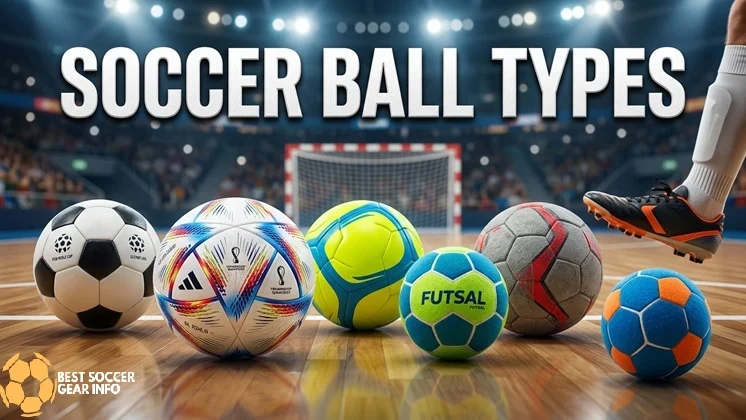
Soccer ball types are differentiated mainly by their purpose, playing surface, construction, and level of competition. The major categories include match, competition, training, recreational, futsal, indoor, beach soccer, turf, and mini or skills balls.
One important distinction is that soccer ball type and soccer ball size are different things. A size 5 ball, for example, can be a match ball, training ball, or recreational ball.
What Are the Different Types of Soccer Balls?
| Soccer ball type | Designed for | Main characteristics |
| Match ball | Competitive matches | High consistency and performance |
| Competition/league ball | Organized competition | Match-oriented performance at a lower price |
| Training ball | Regular practice | Durable construction for repeated use |
| Recreational/club ball | Casual play | General-purpose and affordable |
| Futsal ball | Futsal | Specialized low-bounce characteristics |
| Indoor soccer ball | Indoor soccer | Designed for indoor playing environments |
| Beach soccer ball | Sand | Specialized for beach play |
| Turf ball | Artificial turf | Designed for repeated turf use |
| Mini/skills ball | Skills and casual play | Smaller format for touch and control drills |
FIFA’s football quality program separately recognizes outdoor football, futsal, and beach soccer balls, reflecting the specialized requirements of different forms of the game.
1. Match, Competition, Training, and Recreational Soccer Balls
These four categories cover most conventional outdoor soccer balls.
Match balls
A match ball is designed for competitive games where consistent flight, shape, weight, rebound, air retention, and water resistance are important.
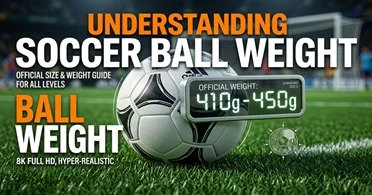
For standard association football, IFAB Law 2 specifies a circumference of 68–70 cm (27–28 inches) and a starting weight of 410–450 g (14–16 oz).
For regulated competitions, the competition organizer determines which specifications and certifications apply.
Competition and league balls
Competition or league balls are designed for organized games but may sit below premium professional match balls in price and construction.
They are suitable for:
- Club leagues
- School competitions
- Amateur tournaments
- Regular competitive games
Training balls
A training ball is built for repeated practice. Durability and value are often more important than having the highest-level match construction.
Training balls are useful for:
- Passing drills
- Shooting practice
- Team training
- Scrimmages
- Individual practice
Recreational and club balls
Recreational balls are intended for casual soccer, parks, backyards, and general-purpose play. They can vary significantly in quality, so check their size, construction, material, and intended surface before buying.
Quick comparison
| Feature | Match | Competition/League | Training | Recreational |
| Primary use | Official/competitive games | Organized competition | Practice | Casual play |
| Performance focus | Maximum consistency | Competitive consistency | Durability and consistency | General usability |
| Typical price | Higher | Moderate to high | Moderate | Lower |
| Best for | Matches | Leagues and tournaments | Frequent practice | Casual players |
A premium match ball is not necessarily the most practical ball for everyday training.
2. Futsal Balls
A futsal ball is designed specifically for futsal rather than conventional outdoor soccer.
Futsal balls are generally associated with a size 4 format, but they are not simply ordinary size 4 soccer balls. Their construction and playing characteristics are designed for the smaller futsal court.
A major distinction is their lower-bounce behavior, which helps players maintain control in a smaller playing area.
Futsal vs. outdoor soccer ball
| Feature | Futsal ball | Outdoor soccer ball |
| Primary surface | Indoor court | Grass or turf |
| Typical size | Size 4 | Size 5 for adult play |
| Bounce | Lower | Designed for outdoor play |
| Playing area | Smaller | Larger |
| Main requirement | Close control | Longer passing and flight |
If your league calls the sport “indoor soccer,” check its rules before buying a futsal ball because indoor soccer and futsal are not necessarily the same game.
3. Beach Soccer Balls
A beach soccer ball is specifically designed for play on sand.
FIFA describes beach soccer balls as having a 68–70 cm circumference and a 400–440 g weight, making them lighter than the standard 410–450 g outdoor football specification.
Beach soccer also uses a different pressure specification from conventional outdoor football.
The important point is that a normal size 5 soccer ball is not automatically a beach soccer ball. Beach play has its own equipment requirements.
4. Indoor and Turf Soccer Balls
Indoor soccer balls
Indoor soccer covers several forms of indoor play, so ball specifications can vary between leagues and facilities.
Some indoor balls are designed to provide controlled handling and bounce in enclosed playing areas.
If you play in an organized indoor league, use the ball specified by that league rather than assuming that a futsal ball is suitable.
Turf soccer balls
Turf-oriented balls are intended for artificial-turf environments.
Synthetic turf can place different demands on a ball than natural grass, particularly when the ball is used frequently. For regular turf training, prioritize a ball whose manufacturer identifies it as suitable for that playing environment.
5. Mini and Skills Soccer Balls
Mini and skills balls are smaller balls intended for ball-control exercises, footwork, casual play, and certain youth applications.
They can be useful for:
- Touch drills
- Close-control exercises
- Footwork
- Ball mastery
- Casual play
They should not be confused with regulation match balls.
Manufacturers use different sizes for skills products, so check the individual product specification rather than assuming every mini or skills ball is the same size.
Soccer Ball Types by Purpose
Instead of memorizing every product category, match the ball to how you intend to use it:
| Your purpose | Suitable category |
| Competitive outdoor match | Match ball |
| League or tournament | Competition/league ball |
| Regular team practice | Training ball |
| Park or backyard play | Recreational/club ball |
| Futsal | Futsal ball |
| Beach soccer | Beach soccer ball |
| Indoor soccer | Indoor-specific ball |
| Artificial turf | Turf-oriented ball |
| Skills and touch drills | Mini/skills ball |
This is often the easiest way to choose a soccer ball.
Soccer Ball Type vs. Soccer Ball Size
Ball type tells you what the ball is designed for; ball size tells you how large it is.
These are related but separate specifications.
For example:
- Size 5 + match ball = standard adult competitive soccer
- Size 5 + training ball = regular outdoor practice
- Size 4 + futsal ball = futsal
- Size 1 + mini ball = skills or casual use
A size number by itself does not tell you the ball’s construction, quality, playing surface, or intended purpose.
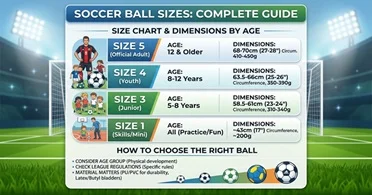
For the complete age and size breakdown, see our [soccer ball sizes] guide.
Are There Size 6, 7, or 8 Soccer Balls?
Standard soccer sizing does not continue upward through size 6, 7, and 8 as normal match-ball categories.
Some products may use higher numbers in names or descriptions, but that does not necessarily mean they represent official soccer-ball sizes.
When shopping, check the manufacturer’s stated circumference and intended use rather than relying solely on a number in the product name.
Soccer Ball Weight, Pressure, and Measurements
Weight and pressure are attributes of a soccer ball, not separate ball types.
For a standard association-football ball, IFAB specifies:
| Measurement | Standard requirement |
| Circumference | 68–70 cm |
| Circumference | 27–28 in |
| Weight | 410–450 g |
| Weight | 14–16 oz |
| Pressure | 0.6–1.1 atm |
| Pressure | Approximately 8.5–15.6 psi |
Specialized balls can have different specifications. Beach soccer balls, for example, use a lighter weight range.
For a deeper explanation, see our [soccer ball weight] guide.
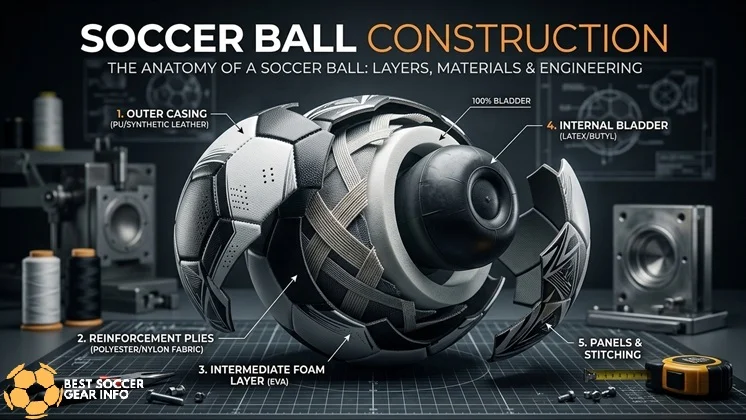
Soccer Ball Construction and Materials
Ball type is only one part of a soccer ball’s design. Construction and materials also affect how a ball feels and performs.
Common construction methods include:
- Thermally bonded panels
- Machine-stitched panels
- Hand-stitched panels
Common materials and components include:
- Polyurethane (PU)
- Thermoplastic polyurethane (TPU)
- Synthetic leather
- Rubber bladders
- Butyl bladders
- Latex bladders
- Internal foam or reinforcement layers
Premium match balls often use more sophisticated construction, while training and recreational balls commonly prioritize durability and value.
For more detail, see our guides to [soccer ball construction] and [soccer ball materials].
Adidas Soccer Ball Types
Adidas produces soccer balls across several categories rather than using one design for every purpose.
Its range includes:
- Match balls
- Competition balls
- League balls
- Training balls
- Club balls
- Mini balls
- Futsal balls
- Beach soccer balls
Trionda soccer ball types
Trionda is adidas’s ball family associated with the 2026 FIFA World Cup.
The range includes versions such as:
| Trionda version | Main purpose |
| Trionda Pro | Match play |
| Trionda Competition | Competition |
| Trionda League | League and general play |
| Trionda Training | Training |
| Trionda Club | Everyday use |
| Trionda Mini | Skills and casual play |
The important distinction is that Trionda is a product family, not one single type of soccer ball. The specific version determines its intended use.
Nike Soccer Ball Types
Nike also sells soccer balls across multiple performance and use categories.
Its range includes products such as:
- Academy
- Academy Elite
- Academy Plus
- Pitch
- Control
- Legacy Elite
- NWSL balls
- Skills balls
Nike also offers different sizes within its range.
As with adidas, the brand name alone does not tell you the ball’s intended use. Check the specific model, size, construction, and playing environment.
How to Choose the Right Soccer Ball Type
Use this order when selecting a ball:
1. Choose the playing surface
Determine whether you will play on:
- Natural grass
- Artificial turf
- Indoor court
- Futsal court
- Sand
2. Choose the purpose
Decide whether the ball is mainly for:
- Competition
- Training
- Recreation
- Skills practice
3. Choose the correct size
Size depends on the player’s age, competition rules, and type of soccer.
4. Check construction and materials
Look at the panel construction, outer material, bladder, and durability.
5. Check certification when necessary
For regulated competition, use the specifications required by the relevant competition or governing body.
This approach is more useful than choosing a ball based solely on brand, graphics, or price.
Common Soccer Ball Mistakes
Assuming every size 5 ball is the same
Size 5 only describes the size category. Two size 5 balls can differ substantially in construction, materials, durability, certification, and intended use.
Using an ordinary soccer ball for futsal
A futsal ball has specialized characteristics, including lower-bounce behavior.
Buying a premium match ball for every practice
A training ball may be more practical for frequent use because it is specifically designed for repeated practice.
Choosing based only on appearance
Graphics and color do not tell you whether a ball is suitable for matches, training, futsal, beach soccer, or turf.
Ignoring the playing surface
The correct ball for grass is not necessarily the correct ball for sand, indoor courts, or artificial turf.
Confusing brand names with ball types
Adidas, Nike, and other manufacturers sell multiple ball categories. Always check the specific model.
Frequently Asked Questions
The main types are match, competition/league, training, recreational, futsal, indoor, beach soccer, turf, and mini/skills balls.
Professional outdoor matches use balls that meet the applicable competition requirements. FIFA and other competition organizers specify the relevant standards and certifications.
A match ball emphasizes competitive performance and consistency, while a training ball is designed for frequent practice and durability.
A training soccer ball is designed specifically for repeated practice. Choose its size and surface compatibility according to the players and field.
Futsal uses a specialized futsal ball, generally associated with size 4 and designed for lower bounce and indoor play.
A beach soccer ball is designed specifically for sand and has different weight and pressure specifications from a standard outdoor football.
No. Size 5 only identifies the size category. Match, training, recreational, and competition balls can all be size 5 while differing in construction and purpose.
No. Futsal balls are generally size 4, but their construction and playing characteristics are specialized for futsal.
They are not standard continuation sizes for conventional match soccer. If a product uses such a number, check its actual manufacturer specifications.
Adidas offers match, competition, league, training, club, mini, futsal, and beach soccer balls, among other product categories.
Nike offers categories and product families including Academy, Academy Elite, Academy Plus, Pitch, Control, Legacy Elite, NWSL, and skills balls.
The Trionda family includes different versions for match, competition, league, training, club, and mini use.
Final Takeaway
The easiest way to understand soccer ball types is to separate them into three questions:
- What will you use the ball for? — match, training, recreation, or skills.
- Where will you play? — grass, turf, indoor court, futsal court, or sand.
- What specifications do you need? — size, weight, construction, materials, and certification.
Once those factors are clear, choosing between a match, training, futsal, beach, indoor, turf, or recreational ball becomes much simpler. For the next step, see our soccer ball sizes, soccer ball weight, soccer ball construction, and soccer ball materials guides, or compare products in our best soccer balls guide.