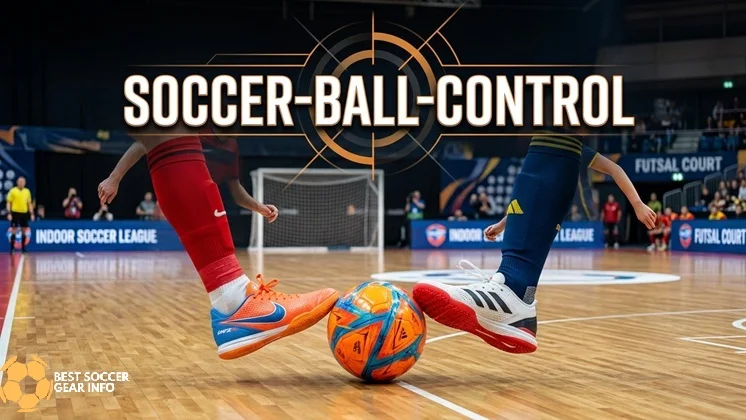
Soccer ball control is the ability to receive, stop, move, and protect the ball so it stays close enough to play the next action. A player who keeps the ball under control is demonstrating ball control, often described as close control or ball mastery when the focus is on repeated technical touches.
Good ball control is more than simply stopping a soccer ball. It includes the first touch, receiving the ball from different directions, manipulating it with different parts of the foot and body, changing direction, dribbling in tight spaces, and preparing the next pass, shot, or movement.
For players learning how to control a soccer ball, the most useful approach is to practice simple touches first and then gradually add movement, speed, direction changes, pressure, and decision-making. U.S. Soccer coaching material similarly emphasizes keeping the ball close, using different surfaces of the foot, and combining a good first touch with a change of direction.
What Is Ball Control in Soccer?
Ball control in soccer means maintaining possession of the ball while directing it into a useful position for your next action.
For example, when a teammate passes the ball to you, you may use your first touch to:
- Stop the ball.
- Move it into space.
- Turn away from a defender.
- Set up a pass.
- Prepare for a shot.
- Begin a dribble.
- Protect the ball from pressure.
The phrase “what is it called when a player keeps the ball under control?” can therefore be answered simply: ball control. When a player keeps the ball especially close while manipulating it through small touches, the skill is often called close ball control.
Ball control and dribbling are related but not identical. Control is about receiving and manipulating the ball effectively; dribbling involves carrying or moving the ball with your feet while progressing through space, often with defenders or obstacles involved.
Why Is Soccer Ball Control Important?
Strong ball control gives a player more options after receiving the ball.
A controlled first touch can help a player:
- Keep possession.
- Create space.
- Escape pressure.
- Change direction quickly.
- Pass more accurately.
- Shoot without needing unnecessary extra touches.
- Dribble more effectively.
- Play with either foot.
- Receive difficult passes.
- Make the next decision faster.
The first touch is particularly important because it connects receiving the ball with whatever comes next. U.S. Soccer coaching material explicitly identifies the first touch as something that can set up the next action, while its youth sessions emphasize keeping the ball close and using the inside and outside of the foot.
How to Control a Soccer Ball
The basic process is simple:
Watch the ball → prepare your body → choose a contact surface → cushion or redirect the ball → move it into useful space → perform the next action.
1. Get your body ready
Stay balanced rather than standing rigidly. Keep your knees slightly bent and adjust your position so you can meet the ball rather than reaching awkwardly for it.
2. Watch the ball
Track its speed, height, direction, and the amount of space available around you.
3. Choose the right surface
Your foot is not a single control surface. The inside, outside, sole, laces, and other areas can all be useful depending on the situation.
4. Cushion the ball
When receiving a fast pass, avoid allowing the ball to simply bounce away from you. A softer touch can absorb some of its momentum and keep it nearby.
5. Direct the first touch
Stopping the ball completely is not always the objective. Often, the better touch moves it toward open space or away from pressure.
6. Take the next action
After controlling the ball, pass, dribble, shoot, turn, or protect possession.
Types of Ball Control in Soccer
There are several ways to classify ball control. The most useful distinction is by how the ball arrives and what the player needs to do with it.
| Type of control | Typical situation | Common control surfaces |
| Ground-ball control | Ball arrives along the ground | Inside, outside, sole |
| Receiving a pass | Teammate plays the ball to you | Inside/outside of foot |
| High-ball control | Ball arrives in the air | Thigh, chest, foot |
| Directional control | First touch moves into space | Inside/outside of foot |
| Close control | Ball stays very close while moving | Inside, outside, sole |
| Turning control | Receive and immediately change direction | Inside/outside/sole |
| Pressure control | Defender is close | Body, foot, sole, shielding |
| Dribbling control | Player moves with the ball | Multiple foot surfaces |
The exact technique depends on the speed, height, direction, pressure, and intended next action.
The Main Parts of the Foot Used for Ball Control
Inside of the Foot
The inside of the foot provides a relatively large surface and is one of the easiest areas for beginners to use when receiving a ground pass.
It can be useful for:
- Controlling passes.
- Taking a first touch.
- Moving the ball sideways.
- Changing direction.
- Setting up a pass.
Outside of the Foot
The outside can help a player take the ball away from pressure or change direction without taking a large touch.
It becomes particularly useful as players become comfortable manipulating the ball with both feet.
Sole of the Foot
The sole can be used to stop, pull, roll, or reposition the ball.
It is especially useful for close-control exercises and situations where a player needs to keep the ball underneath or immediately beside the body.
Laces
The laces are generally associated more with striking and carrying the ball at speed than delicate receiving. However, they can still be involved when taking certain forward touches.
Thigh and Chest
Not every ball arrives on the ground.
When a ball comes through the air, a player may use the thigh or chest to bring it down before playing the next action.
What Is a First Touch?
A first touch is the first controlled contact a player makes when receiving the ball.
A good first touch does not necessarily mean stopping the ball directly underneath you. In many situations, the purpose is to place the ball where you can play it next.
For example:
Pass arrives → first touch into space → player accelerates → next pass or dribble.
This is why first-touch practice should eventually include movement rather than consisting only of stationary ball touches.
U.S. Soccer’s coaching resources use exercises in which players receive a pass, take a controlled touch into a grid, and then change direction.
Soccer Ball Control Drills
You do not need complicated equipment to practice ball control. A soccer ball, a small area, and a few markers or cones can provide plenty of options.
1. Inside-Inside Touches
Tap the ball between the insides of your feet.
How to do it:
- Stand over the ball.
- Touch it with the inside of one foot.
- Receive it with the inside of the other.
- Continue alternating.
- Gradually increase your rhythm.
This is a simple starting exercise for beginners.
2. Inside-Outside Touches
Use the inside and outside of the same foot to move the ball from side to side.
How to do it:
- Push the ball slightly with the inside.
- Bring it back across your body with the outside.
- Repeat.
- Switch feet.
This develops familiarity with different foot surfaces.
3. Sole Rolls
Use the bottom of your foot to roll the ball sideways.
How to do it:
- Place the sole lightly on the ball.
- Roll it across your body.
- Stop it with the opposite foot.
- Roll it back.
- Repeat continuously.
4. Pull-Push Drill
Pull the ball backward with the sole and then push it forward.
This teaches players to manipulate the ball while changing direction.
5. Cone Slalom
Place several cones in a line and dribble between them.
Focus on:
- Small touches.
- Keeping the ball close.
- Using both feet.
- Looking up between touches.
- Changing direction smoothly.
U.S. Soccer youth coaching resources emphasize small touches, close control, and using different foot surfaces when players dribble in confined spaces.
6. Receive and Turn
Have a partner pass the ball toward you.
Control the ball and immediately turn toward an open direction.
Progress the exercise by:
- Increasing the passing distance.
- Using the weaker foot.
- Receiving from different angles.
- Adding a passive defender.
- Requiring a directional first touch.
7. Pass, Receive, Move
Pass against a wall or to a partner.
After receiving the ball:
- Control it.
- Take a directional touch.
- Pass again.
- Move to a new position.
This connects ball control with passing rather than treating the skill as an isolated movement.
FIFA’s Training Centre uses receiving and passing exercises that can be varied through different receiving surfaces, weaker-foot work, volleys, and other technical challenges.
Soccer Ball Control Drills for Beginners
Beginners should prioritize control before speed.
A simple progression is:
| Level | Practice |
| 1 | Stationary inside touches |
| 2 | Inside/outside touches |
| 3 | Sole rolls |
| 4 | Slow dribbling |
| 5 | Cone changes of direction |
| 6 | Receive and turn |
| 7 | Receive, move, and pass |
| 8 | Add passive pressure |
| 9 | Add active pressure |
| 10 | Use the skill in small-sided games |
The goal is not to perform the most complicated drill. The goal is to make the basic touch increasingly reliable.
Soccer Ball Control Drills for Kids
For younger players, drills should generally be simple, active, and easy to understand.
Useful activities include:
- Free dribbling.
- Inside/outside touches.
- Cone dribbling.
- Stop-and-go games.
- Sole rolls.
- Turning around cones.
- Partner receiving.
- Small-sided games.
U.S. Soccer’s youth sessions emphasize dribbling, keeping the ball close, changing direction, and experimenting with different foot surfaces.
Rather than making every exercise highly technical, give children opportunities to touch the ball frequently and make decisions.
U8 and U10 Soccer Ball Control Drills
For U8 soccer ball control drills, keep activities short and game-like. Focus on basic touches, dribbling, changes of direction, and learning to keep the ball close.
For U10 soccer ball control drills, gradually introduce more directional receiving, passing combinations, weaker-foot work, and pressure.
A useful progression is:
U8: control → dribble → change direction → play.
U10: receive → directional touch → scan → dribble/pass → move.
Age should not be the only factor determining difficulty. Players develop at different rates, so the same activity can be made easier or harder by changing space, speed, pressure, or the number of touches.
Soccer Ball Control Drills for Adults
Adults who are beginners can use the same fundamental techniques as younger players.
Start with:
- Inside touches.
- Inside/outside touches.
- Sole rolls.
- Controlled dribbling.
- Cone changes of direction.
- Wall passes.
- Receive-and-turn exercises.
- One-touch and two-touch passing.
More experienced adults can increase difficulty by adding pressure, reducing available space, using the weaker foot, or requiring a directional first touch.
Soccer Ball Control Drills Without a Ball
You can practice some parts of ball control without actually touching a ball, although these exercises cannot replace ball-contact practice.
Useful no-ball exercises include:
Footwork Patterns
Practice quick movements between imaginary points or floor markers.
Body Orientation
Practice receiving an imaginary pass while turning your body toward different directions.
Scanning
Before an imaginary reception, look left and right as if checking for opponents and teammates.
First-Touch Movement
Practice the body movement associated with receiving and taking the ball into space.
Change-of-Direction Footwork
Use cones or floor markers and practice the movement pattern you would use when changing direction with the ball.
The key limitation is that actual ball control requires contact with the ball, so no-ball work should complement rather than replace ball practice.
How to Improve Soccer Ball Control
If you want better ball control, practice the skill in stages rather than simply repeating one drill at the same difficulty.
Stage 1: Improve Familiarity
Use both feet and different contact surfaces.
Stage 2: Improve Touch Quality
Try to keep touches controlled and purposeful.
Stage 3: Add Movement
Control the ball while walking and then jogging.
Stage 4: Add Direction
Take your first touch into different areas of space.
Stage 5: Add Speed
Increase the pace while maintaining control.
Stage 6: Add Pressure
Introduce a passive or active defender.
Stage 7: Add Decisions
Require yourself to choose between turning, passing, dribbling, or protecting the ball.
This progression reflects an important principle in soccer training: isolated technical work becomes more useful when players eventually have to apply the skill in realistic game situations. FIFA’s training resources describe adapting exercises to player needs and increasing or reducing their difficulty.
How to Improve Ball Control and Dribbling
Ball control and dribbling should be trained together, but they have slightly different demands.
Ball control: Can you receive and manipulate the ball?
Dribbling: Can you move with the ball while maintaining possession?
To develop both:
- Use small touches in tight spaces.
- Practice with both feet.
- Change direction frequently.
- Practice accelerating after a touch.
- Keep your head up periodically.
- Use different parts of the foot.
- Practice against passive pressure.
- Progress to active defenders.
- Apply the skill in small-sided games.
A useful drill sequence is:
Control → change direction → accelerate → slow down → change direction again.
Soccer Drills for Ball Control and Passing
Ball control becomes much more useful when it connects directly to passing.
Try this simple partner drill:
Player A → pass → Player B controls → directional touch → return pass → move.
Progress it by:
- Using the weaker foot.
- Increasing the passing distance.
- Receiving from different angles.
- Limiting the number of touches.
- Adding a defender.
- Requiring the receiver to turn.
FIFA’s Training Centre provides receiving-and-passing activities where players can work on clean receptions and vary the technical demands of the exercise.
Indoor Soccer Ball Control Drills
Indoor spaces are useful for close-control practice because limited space naturally encourages smaller touches.
Good indoor exercises include:
- Sole rolls.
- Inside/outside touches.
- Tight cone dribbling.
- Wall passes.
- Receive-and-turn drills.
- Short passing combinations.
- Direction-change drills.
Keep the practice area appropriate for the activity and avoid creating unnecessary collisions with other players or objects.
Soccer Ball Control With Cones
Cones can be used to create simple constraints.
Straight Slalom
Dribble through a line of cones.
Box Control
Create a square and control the ball while moving around its edges.
Figure Eight
Dribble around two cones in a figure-eight pattern.
Gate Passing
Create small gates and pass or dribble through them.
Directional First Touch
Have a partner pass the ball while you use the first touch to move it through a designated gate.
Cones are valuable not because they magically improve control, but because they provide a visual target that forces the player to change direction and manage space.
Soccer Ball Control Exercises
A balanced individual session can include several categories:
| Exercise category | Main purpose |
| Stationary touches | Familiarity with the ball |
| Sole rolls | Close manipulation |
| Inside/outside touches | Foot-surface control |
| Dribbling | Ball movement |
| Cone work | Direction changes |
| Wall passing | Receiving and passing |
| Receive-and-turn | Directional first touch |
| Pressure drills | Game-related control |
| Small-sided games | Applying the skill |
Instead of doing one exercise for a long period, combine several types of work.
Soccer Ball Control Equipment
You do not need specialized equipment to learn ball control.
Soccer Ball Control Bands
Resistance bands may be used for general athletic or footwork exercises, but they are not necessary for learning the basic skill of controlling a soccer ball.
Soccer Ball Control Mat
A training mat can provide a defined surface or target area for certain technical exercises, but a normal safe playing surface is sufficient for many ball-control drills.
Cones
Cones are among the simplest tools for creating dribbling lanes, gates, grids, and directional targets.
For most beginners, a suitable soccer ball and enough safe space are more important than specialized ball-control equipment.
Can You Learn Ball Control With Any Soccer Ball?
Yes. For basic practice, you can develop ball-control skills with an appropriately sized soccer ball.
The important factors are that the ball is properly inflated according to its specifications, suitable for the player’s age and activity, and safe to use on the intended surface.
For technical practice, the objective is to become comfortable controlling the ball rather than relying on a particular brand.
Soccer Cleats for Ball Control
Soccer cleats can affect how a player feels the ball, but footwear does not create good ball control by itself.
When choosing soccer cleats for technical practice, consider:
- Proper fit.
- Comfort.
- Surface compatibility.
- Traction.
- Freedom of movement.
- Ball feel.
A player should be able to move naturally and safely. Technique comes from practice, not simply from changing footwear.
Common Ball-Control Mistakes
Taking Touches That Are Too Large
A large touch can give the defender time to challenge.
Fix: Practice smaller touches when space is limited.
Always Using the Same Foot
This limits the directions available to you.
Fix: Include your weaker foot in regular practice.
Looking Only at the Ball
You need to know what is happening around you.
Fix: Practice looking up between touches.
Trying to Move Too Fast
Speed without control creates mistakes.
Fix: Slow the drill down, improve the touch, then increase speed.
Always Stopping the Ball Completely
A dead stop is not always the best first touch.
Fix: Practice directional touches into open space.
Practicing Only Without Pressure
A perfect touch in an empty space does not automatically transfer to a match.
Fix: Gradually introduce opponents, smaller spaces, and decision-making.
Ball Control vs. Dribbling
| Skill | Main purpose |
| Ball control | Receive and manipulate the ball effectively |
| First touch | Control the first contact after receiving |
| Close control | Keep the ball close during manipulation |
| Dribbling | Move with the ball while maintaining possession |
| Ball mastery | Develop familiarity and technical command through repeated touches |
| Trapping | Controlling an incoming ball, particularly in traditional soccer terminology |
These skills overlap, but they are not interchangeable.
For example, a player can have a good first touch without being an advanced dribbler. Similarly, an excellent dribbler still needs reliable control when receiving difficult passes.
What Is a Heavy Touch in Soccer?
A heavy touch is a touch that sends the ball farther away from the player than intended.
For example, a player receives a pass but their first contact pushes the ball several yards away. That can give an opponent an opportunity to win possession.
A heavy touch is not always bad. A larger touch can sometimes be intentional when a player has open space and wants to accelerate.
The important question is whether the touch is appropriate for the situation.
Ball Security and Protecting Possession
Ball security means reducing the chances of losing possession unnecessarily.
When an opponent is close:
- Keep your body between the defender and the ball.
- Use controlled touches.
- Keep the ball within playing distance.
- Use your body to protect possession.
- Look for a teammate or escape route.
- Do not take unnecessary touches into pressure.
Good ball control is therefore connected to decision-making, not just foot technique.
Soccer Ball Control PDF
A useful printable soccer ball-control practice sheet can organize training into four sections:
| Section | Exercises |
| Warm-up | Inside touches, sole rolls |
| Ball mastery | Inside/outside, pull-push |
| Movement | Cone dribbling, turns |
| Game application | Receive, turn, pass, dribble |
For a beginner session, start with simple touches and progress toward movement and decision-making. FIFA’s coaching resources similarly structure football practice around skill development and applying skills in game situations.
How Long Should You Practice Soccer Ball Control?
The useful amount depends on the player’s age, level, schedule, and overall training load.
Rather than chasing a specific number of hours, prioritize regular, focused practice.
A simple individual session could be:
- Ball mastery: 5–10 minutes
- Direction changes: 5–10 minutes
- Passing/receiving: 10 minutes
- Dribbling: 10 minutes
- Game-like practice: 10–15 minutes
The exact duration can be adjusted to the player and training environment.
How to Build a Soccer Ball-Control Training Session
A practical session can follow this sequence:
1. Warm Up
Begin with easy movement and touches.
2. Ball Mastery
Practice different surfaces and basic movements.
3. Controlled Movement
Add cones and directional changes.
4. Receiving
Practice first touches from passes.
5. Pressure
Add a defender or reduce available space.
6. Game Application
Use small-sided play or realistic scenarios.
This approach connects isolated technique with actual soccer decisions. FIFA describes football sessions that move from warm-up and skill development toward game application, while U.S. Soccer resources also use activities that place technical skills into active game environments.
Frequently Asked Questions
Ball control is the ability to receive, manipulate, and keep the soccer ball in a useful position while preparing for the next action.
It is called ball control. When the player keeps the ball particularly close while manipulating it, the term close control is also commonly used.
Prepare your body, watch the ball, choose the appropriate contact surface, cushion or redirect the ball, and take the ball into a useful position for your next action.
Common forms include ground-ball control, receiving passes, directional first touches, close control, turning control, high-ball control, and control under pressure.
Practice regularly with both feet, use different foot surfaces, start with controlled touches, add movement and direction changes, and gradually introduce pressure and game situations.
Useful drills include inside touches, inside-outside touches, sole rolls, pull-push movements, cone dribbling, receive-and-turn exercises, wall passing, and pressure-based activities.
You can practice footwork, body positioning, scanning, and movement patterns without a ball, but actual ball contact is necessary to develop the physical touch required for ball control.
Inside touches, sole rolls, inside/outside touches, slow dribbling, cone work, and simple receive-and-pass drills are good starting points.
Simple dribbling games, small-touch exercises, cone activities, turning games, and basic receiving activities work well. The difficulty should be adjusted to the player’s development rather than relying only on age.
A heavy touch is an uncontrolled or overly large touch that moves the ball farther away than intended. A larger touch can sometimes be intentional when there is open space.
No. Ball control is the broader ability to receive and manipulate the ball. Dribbling specifically involves moving with the ball while maintaining possession.
Cleats can affect comfort, traction, and how a player feels the ball, but they do not replace technical practice.
No. Specialized equipment is optional. A suitable soccer ball and safe practice space are enough for many ball-control exercises.
Yes. Adults can practice the same fundamental techniques and progressively increase the difficulty through movement, speed, weaker-foot work, pressure, and decision-making.
Start with simple inside-foot touches, sole rolls, and slow dribbling. Once those feel comfortable, add direction changes, passing, and receiving.
Final Takeaway
Soccer ball control is the ability to receive and manipulate the ball so it remains available for your next action. The foundation is a controlled first touch, but advanced control also involves direction, speed, different contact surfaces, both feet, pressure, awareness, and decision-making.
Start with simple ball-control exercises. Then progress from stationary touches to movement, from movement to directional control, and finally from isolated drills to realistic soccer situations.
The goal is not simply to touch the ball more times. The goal is to make each touch controlled, purposeful, and useful for what happens next.