If you are buying a soccer goal for a backyard, youth team, training session, or regulation match, the right size depends on who will use it, where it will be used, and whether it needs to meet competition specifications.
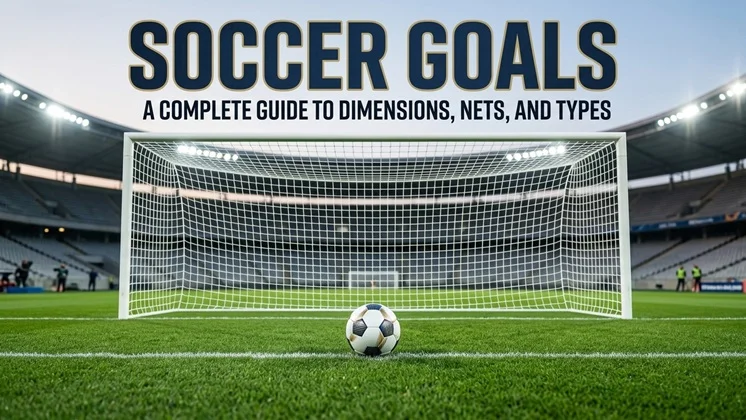
A regulation adult soccer goal is 24 feet wide and 8 feet high (7.32 m × 2.44 m). Youth and training goals are considerably smaller, with common sizes such as 4 × 6 feet, 6.5 × 18.5 feet, and 7 × 21 feet used for different age groups and formats.
For backyard practice, portable and pop-up goals are usually more practical than full-size match goals. For organized competition, the required goal dimensions depend on the competition’s rules.
What Is a Soccer Goal?
A soccer goal is the framed target at each end of the field that players attempt to score in. A standard goal consists of:
- Two vertical goalposts
- One horizontal crossbar
- A supporting frame
- A goal net
- Net supports or a rear frame, depending on the design
- Anchoring equipment for portable goals
Under the Laws of the Game, the goalposts and crossbar must be made from approved material and must not be dangerous. The posts and crossbar must have the same shape, and their width and depth cannot exceed 12 cm (5 inches).
The goal is positioned at the center of each goal line. The net catches the ball after it crosses the goal line and makes it easier to determine whether a shot entered the goal.
How Big Is a Regulation Soccer Goal?
A regulation full-size soccer goal is:
| Measurement | Regulation size |
| Width | 24 ft (7.32 m) |
| Height | 8 ft (2.44 m) |
| Goalpost/crossbar maximum width | 5 in (12 cm) |
| Goalposts | 2 |
| Crossbar | 1 |
The 7.32 m × 2.44 m dimensions are specified by the International Football Association Board (IFAB) for the standard full-size goal used in the Laws of the Game.
In everyday American measurements, this is normally described as a 24-foot-wide by 8-foot-high soccer goal.
How Tall Are Soccer Goals?
A full-size soccer goal is 8 feet tall, measured from the ground to the lower edge of the crossbar.
Youth goals can be much shorter. For example, US Youth Soccer’s published small-sided development chart lists maximum goal sizes of 4 feet high × 6 feet wide for U6-U8, 6.5 feet high × 18.5 feet wide for U9-U10, and 7 feet high × 21 feet wide for U11-U12.
How Wide Are Soccer Goals?
A regulation adult goal is 24 feet wide from the inside of one post to the inside of the other.
Youth, training, mini, and backyard goals can range from only a few feet wide to regulation size.
Soccer Goal Sizes by Age and Playing Format
There is no single soccer goal size for every age group. Smaller goals are commonly used for small-sided youth games and training.
One useful U.S. Youth Soccer reference provides the following maximum goal dimensions:
| Age group | Players | Maximum goal size | Typical ball size in USYS chart |
| U6 | 4v4 | 6 × 4 ft | Size 3 |
| U7 | 4v4 | 6 × 4 ft | Size 3 |
| U8 | 4v4 | 6 × 4 ft | Size 3 |
| U9 | 7v7 | 18.5 × 6.5 ft | Size 4 |
| U10 | 7v7 | 18.5 × 6.5 ft | Size 4 |
| U11 | 9v9 | 21 × 7 ft | Size 4 |
| U12 | 9v9 | 21 × 7 ft | Size 4 |
US Youth Soccer’s published chart gives these goal-size limits alongside its small-sided game recommendations.
Important: youth soccer organizations, leagues, tournaments, and states can use different rules. Check the specific competition rules before buying a goal for league play.
For older youth players moving toward 11v11 soccer, the standard full-size goal becomes the relevant reference point.
Main Types of Soccer Goals
Soccer goals are available in several designs. The best type depends more on the intended use than on the appearance of the goal.
1. Regulation Soccer Goals
Regulation goals are designed for organized full-size soccer.
The standard adult goal is 24 × 8 feet. These goals are typically larger, heavier, and more expensive than backyard or training goals.
They are suitable for:
- Competitive matches
- Soccer clubs
- Schools
- Stadiums
- Full-size practice fields
- Adult 11v11 soccer
Permanent match goals can require more installation and field infrastructure than portable models.
2. Portable Soccer Goals
Portable soccer goals are designed to be moved, stored, or transported.
They are useful when the same field needs to serve different activities or when a backyard player does not want a permanently installed goal.
Portable goals can range from small training models to full-size competition-style designs.
Look for:
- Strong frame construction
- Secure anchoring
- Durable net attachment
- Easy assembly
- Manageable storage
- Appropriate dimensions for the intended game
Safety matters: a portable goal should be properly anchored according to the manufacturer’s instructions. US Youth Soccer specifically notes that portable goals should be properly anchored.
3. Pop-Up Soccer Goals
Pop-up goals are lightweight training goals that can be set up quickly.
They are particularly useful for:
- Backyard practice
- Passing drills
- Shooting practice
- Small-sided games
- Individual training
- Travel
- Camps
Their main advantage is convenience. They can be folded or collapsed for transportation and storage.
Because they are generally designed for training rather than full-size competitive matches, always check the manufacturer’s dimensions and construction before assuming a pop-up goal is regulation size.
4. Mini Soccer Goals
Mini soccer goals are compact goals intended for younger players, small spaces, or technical drills.
They can be useful indoors or outdoors depending on their construction.
Common uses include:
- First-touch drills
- Passing
- Finishing
- 1v1 games
- Backyard games
- Small-sided activities
A mini goal is not automatically a youth league regulation goal. Its purpose is usually convenience and skill development rather than competition compliance.
5. Small Soccer Goals
Small goals occupy the space between mini training goals and larger youth goals.
They work well when a full-size goal would take up too much space.
For a backyard, consider the available playing area first. A goal should leave enough room around it for players to move safely rather than forcing shots and runs into fences, walls, trees, or other obstacles.
6. Backyard Soccer Goals
Backyard goals are designed primarily for recreational play and practice.
The best size depends on the age of the players and the available space.
For younger children, a small goal can be enough. Older players may prefer a larger portable goal that provides more realistic shooting practice.
When choosing a backyard goal, consider:
- Available yard space
- Player age
- Goal dimensions
- Portability
- Frame material
- Net durability
- Anchoring system
- Storage requirements
- Whether it will remain outside
- Whether it needs to approximate match play
A backyard goal does not need to be 24 × 8 feet simply because that is the adult regulation size.
Soccer Goals for Training
Training goals are designed around practice rather than official matches.
They can be used for:
- Shooting
- Finishing
- Passing
- Crossing
- Small-sided games
- Attacking drills
- Goalkeeper practice
- 1v1 exercises
- Technical training
Training goals come in many sizes. Some are deliberately smaller to force accuracy, while larger portable goals can simulate match conditions.
Kwik Goal, for example, offers separate categories for game goals, soccer training goals, futsal goals, and related equipment.
Indoor Soccer Goals and Futsal Goals
Indoor soccer and futsal do not necessarily use the same goals as outdoor 11v11 soccer.
A standard futsal goal measures 3 meters wide × 2 meters high, or approximately 9.84 × 6.56 feet.
That is significantly smaller than the standard outdoor soccer goal of 7.32 × 2.44 meters.
If you play futsal, buy a goal designed for futsal rather than assuming an outdoor soccer goal is appropriate.
Metal Soccer Goals vs. Lightweight Goals
The frame material affects durability, weight, portability, and price.
Metal soccer goals
Metal frames can be made from materials such as aluminum or steel. They are commonly used for larger and more durable goals.
Advantages can include:
- Strong construction
- Greater durability
- Better suitability for frequent use
- Larger goal options
The trade-off is that larger metal goals can be heavier and harder to transport.
Lightweight training goals
Lightweight goals are easier to move and store.
They are often preferable for:
- Backyard practice
- Coaches who move equipment frequently
- Camps
- Small-sided training
- Temporary setups
The key is matching the construction to the intended use rather than simply choosing the heaviest goal available.
What Is a Full-Size Soccer Goal?
A full-size soccer goal is the standard goal used for adult 11v11 soccer.
Its official dimensions are:
24 feet wide × 8 feet high
or
7.32 meters wide × 2.44 meters high.
A full-size goal is substantially larger than most youth, backyard, pop-up, and mini goals.
For example:
| Goal type | Example size | Typical use |
| Mini | Small training dimensions | Young children, drills |
| U6-U8 | Up to 6 × 4 ft | Small-sided youth play |
| U9-U10 | Up to 18.5 × 6.5 ft | Youth 7v7 |
| U11-U12 | Up to 21 × 7 ft | Youth 9v9 |
| Full size | 24 × 8 ft | Adult/full-size soccer |
The youth dimensions above come from the US Youth Soccer development chart; individual leagues may have their own requirements.
Soccer Goal Set of 2: Do You Need Two Goals?
A conventional soccer game requires two goals, one at each end of the field.
However, buying two goals is not always necessary for individual training.
A single portable goal can be useful for:
- Shooting practice
- Finishing
- Goalkeeper drills
- Passing exercises
- Backyard practice
A set of two soccer goals is more useful when you want to create a complete small-sided playing area.
For portable training, two matching goals also make it easier to create a small game with consistent dimensions at both ends.
How to Choose Soccer Goals for a Backyard
If your primary question is “What are the best soccer goals for backyards?”, start with the playing environment rather than the brand.
For young children
Choose a smaller goal that matches their playing format.
A 4 × 6-foot goal, for example, corresponds to the maximum goal dimensions listed by US Youth Soccer for U6-U8 in its published development chart.
For older children
Consider a larger youth goal such as an 18.5 × 6.5-foot or 21 × 7-foot model if the available space and playing format justify it.
For teenagers and adults
A full-size 24 × 8-foot goal can provide realistic match practice, but it requires substantially more space.
For limited yards
A small or pop-up goal is generally easier to manage.
The important point is that bigger is not automatically better. The goal should fit the players, field area, and type of practice.
What to Look for in a Portable Soccer Goal
Before buying a portable goal, check these features.
Frame
Look at the frame material, joints, tubing, and overall construction.
A goal that is frequently transported needs a frame designed for repeated assembly and movement.
Net
Check:
- Net material
- Mesh size
- Attachment method
- Weather resistance
- Replacement availability
A replacement net can extend the useful life of a good frame.
Anchoring
A portable soccer goal should be securely anchored according to its manufacturer’s instructions.
Never assume that a heavy-looking goal is automatically safe from tipping.
Portability
Consider:
- Weight
- Folding mechanism
- Carry bag
- Wheel system
- Assembly time
- Storage dimensions
A goal that is technically excellent but too difficult to move may not be practical for backyard use.
Popular Soccer Goal Brands and Manufacturers
Several manufacturers make soccer goals for different levels of play.
Kwik Goal
Kwik Goal produces game goals, portable match goals, training goals, futsal goals, nets, and other soccer equipment. The company describes itself as the Technical Partner and Official Goal of U.S. Soccer.
Bownet
Bownet offers portable soccer goals, including models in sizes such as 4 × 6 feet, 6.5 × 18.5 feet, 7 × 21 feet, and 8 × 24 feet.
FORZA
FORZA is another brand associated with soccer goals and training equipment. When searching for “FORZA soccer goals,” check the dimensions and intended use of the specific model because the brand offers different goal types and sizes.
Other buying searches
Searches such as soccer goals for sale, soccer goals Amazon, soccer goals near me, and retailer-specific searches usually indicate shopping intent rather than a need to understand soccer goal dimensions.
For a competition goal, verify the actual dimensions and specifications instead of relying only on the product title.
Regulation Soccer Goals vs. Backyard Goals
The main difference is the intended standard.
| Feature | Regulation match goal | Backyard/training goal |
| Typical adult size | 24 × 8 ft | Varies |
| Competition use | Yes | Usually no |
| Portability | Some models | Common |
| Weight | Often heavier | Often lighter |
| Storage | More difficult | Usually easier |
| Price | Usually higher | Wide range |
| Best for | Organized matches | Recreation and practice |
A goal can be high quality without being a regulation match goal.
Likewise, a portable goal can be suitable for serious training without being certified or sized for official competition.
Common Soccer Goal Mistakes
Buying a full-size goal for a small yard
A 24 × 8-foot goal takes up significant space. Measure the entire playing area before purchasing.
Assuming every youth goal is the same
Youth soccer uses different game formats and goal sizes. The appropriate size can change with age and competition rules.
Confusing futsal and outdoor soccer goals
A futsal goal is approximately 3 × 2 meters, while a standard outdoor goal is 7.32 × 2.44 meters.
Ignoring anchoring
Portable goals need proper anchoring. This is particularly important when the goal is used outdoors.
Choosing by brand name alone
A brand may sell several different sizes and designs. Always check the exact dimensions, construction, and intended use of the model.
Soccer Goals and the Meaning of “Goals” in Soccer
The word goal has two meanings in soccer.
It can mean the physical equipment players shoot at, or it can mean a score when the ball legally enters the opponent’s goal.
That distinction matters when searching for terms such as:
- most soccer goals
- most goals in soccer
- most career goals
- most goals in soccer history
- most goals in a season
- who has the most goals in soccer
- who scored the most goals in soccer history
These are soccer scoring statistics, not soccer-equipment searches.
Who Has Scored the Most Goals in Soccer?
There is no single universal answer unless the competition and statistical definition are specified.
For example, Guinness World Records currently lists Cristiano Ronaldo as the men’s international scoring record holder, with 146 international goals for Portugal as of July 2, 2026.
Career totals can differ depending on whether a statistic includes only official senior matches, international matches, club competitions, or other categories.
What Is Four Goals in Soccer Called?
Four goals by one player in a match are commonly described as a four-goal haul. Football terminology does not have one universally standardized special word equivalent to “hat-trick” for four goals. Contemporary football reporting commonly uses “four-goal haul.”
What Is Five Goals in Soccer Called?
Five goals by one player in a match are generally described as a five-goal haul or simply as scoring five goals. There is no universally standardized official term for five goals.
What Is the Most Goals Scored in a Soccer Game?
The answer depends on how the record is defined.
Guinness World Records records a 36–0 first-class match as the highest score by one team in a first-class football match, achieved by Arbroath against Bon Accord in 1885 and later equaled by Infonet FC against Virtsu Jalgpalliklubi in 2015.
A separate and unusual record is the 149–0 result between AS Adema and Stade Olympique L’Emyrne in Madagascar in 2002. All 149 goals were own goals deliberately scored by Stade Olympique L’Emyrne as a protest against refereeing decisions.
Because that match involved deliberate own goals, it should not be treated as equivalent to a normal high-scoring competitive match.
Frequently Asked Questions
A regulation full-size soccer goal is 24 feet wide and 8 feet high, equivalent to 7.32 meters wide and 2.44 meters high.
A full-size soccer goal is 8 feet high. Youth goals can be shorter, such as the 4-foot-high U6-U8 goals listed in US Youth Soccer’s development chart.
A standard adult goal is 24 × 8 feet. Youth and training goals come in many smaller sizes.
The appropriate backyard goal depends on player age, available space, portability, and intended use. Small portable goals work well for limited spaces, while larger goals can provide more realistic shooting practice.
Portable goals should be properly anchored according to the manufacturer’s instructions. US Youth Soccer specifically recommends that portable goals be properly anchored.
Usually not. Pop-up goals are primarily designed for portability and training. Check the individual product’s dimensions before assuming it meets competition requirements.
The answer depends on the age group and league rules. US Youth Soccer’s published chart lists 6 × 4 feet for U6-U8, 18.5 × 6.5 feet for U9-U10, and 21 × 7 feet for U11-U12.
Not necessarily. Futsal goals, for example, measure 3 × 2 meters, substantially smaller than a standard outdoor 11v11 goal.
You need two goals for a conventional game, but one goal can be sufficient for many individual training drills.
A full-size goal is the standard adult goal measuring 24 feet × 8 feet (7.32 × 2.44 meters).
A match goal is designed around competition requirements, while a training goal can prioritize portability, quick setup, smaller dimensions, or specific practice drills.
Metal goals can provide strong, durable frames, but the appropriate construction depends on how the goal will be used. For a backyard, portability and storage can be just as important as frame strength.
Yes. Portable, pop-up, mini, and youth-sized goals are commonly suited to backyard practice. Choose the dimensions according to the available space and players rather than automatically buying a regulation-size goal.
Bottom Line
The standard full-size soccer goal is 24 feet wide × 8 feet high (7.32 × 2.44 m). That is the key measurement to remember for adult 11v11 soccer.
For children, backyard practice, and training, smaller goals are often more practical. US Youth Soccer’s published development chart provides examples ranging from 6 × 4 feet for U6-U8 to 21 × 7 feet for U11-U12.
When choosing a soccer goal, match the goal size, construction, portability, anchoring system, and intended use to the players and playing environment. A regulation goal is appropriate when competition specifications matter; a portable, pop-up, mini, or backyard goal can make more sense when convenience and training are the priority.