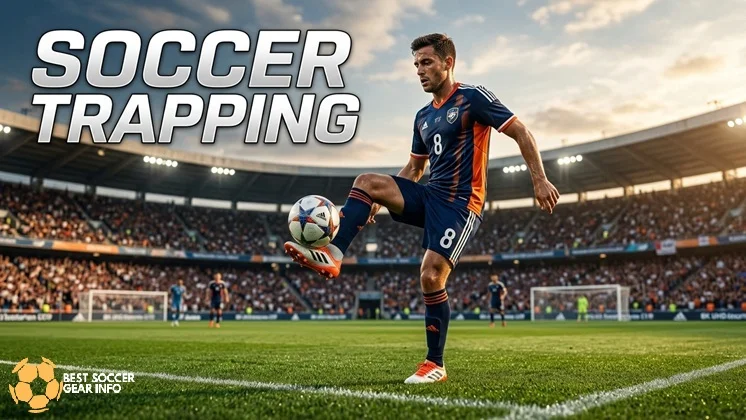
Soccer trapping is the skill of receiving an incoming ball and bringing it under control so you can make your next action—such as passing, dribbling, turning, or shooting. A good trap does not simply stop the ball; it gives the player control while keeping the ball in a useful position.
For beginners, the most important foundation is learning to soften the ball’s impact, choose the right body surface, and prepare the next touch. U.S. Soccer identifies receiving and controlling the ball with different surfaces as part of technical ball mastery.
What Is Trapping in Soccer?
Trapping in soccer means receiving and controlling an incoming ball with a legal part of the body.
The traditional idea of a “trap” is to stop or slow the ball. In modern soccer, however, the better objective is usually controlled receiving: instead of killing the ball completely, you guide it into a position that allows you to play the next action quickly.
For example:
- A ground pass can be trapped with the inside of the foot.
- A bouncing ball can be controlled with the foot, thigh, or another suitable surface.
- A high ball can be brought down with the chest, thigh, or foot.
- A difficult pass can be redirected into open space rather than stopped directly underneath you.
This is why trapping is closely connected to first touch, ball control, receiving, passing, turning, and dribbling.
What Is the Purpose of Trapping the Ball?
The main purpose of trapping is to absorb or reduce the ball’s movement and bring it under control so the player can make the next play.
A successful trap should help you:
- Control an incoming pass.
- Keep possession.
- Move the ball away from pressure.
- Prepare for a pass.
- Prepare for a dribble.
- Turn toward space.
- Protect the ball from an opponent.
- Control a bouncing or aerial ball.
- Change the ball’s direction.
- Play more quickly with fewer unnecessary touches.
The best trap is therefore not always a completely stationary ball. Sometimes the ideal first touch moves the ball into open space.
How to Trap a Soccer Ball
The exact technique depends on the speed, height, direction, and type of incoming ball.
A simple receiving sequence is:
Read → Move → Prepare → Cushion → Direct → Play
1. Read the ball
Watch the ball as it travels toward you.
Judge:
- Its speed
- Height
- Direction
- Bounce
- Distance from you
- Pressure from opponents
2. Move into position
Do not wait for the ball to arrive at your feet if you can move into a better receiving position.
Small adjustments with your feet can make the difference between an easy first touch and a difficult one.
3. Prepare the receiving surface
Select the body surface that best matches the incoming ball.
For a normal ground pass, the inside of the foot is often the simplest option for beginners.
4. Cushion the ball
Instead of making your receiving surface rigid, allow it to move slightly with the ball.
The idea is to reduce the ball’s speed rather than allowing it to rebound away from you.
5. Direct the first touch
Once you have control, move the ball where you want to go next.
For example:
Pass coming from the right → receive across your body → move into space on the left.
6. Make the next play
A trap should connect naturally to the next action:
trap → pass
trap → dribble
trap → turn
trap → shoot
Types of Soccer Trapping
There is no single trapping technique. Players use different surfaces depending on the ball’s trajectory.
| Type of trap | Best used for | Main idea |
| Inside-foot trap | Ground passes | Cushion and control with the inside of the foot |
| Sole trap | Slow ground balls | Place the sole over or on the ball to stop/control it |
| Outside-foot trap | Balls arriving from an angle | Control while keeping the ball on the outside |
| Instep trap | Certain rolling or aerial balls | Use the top/laces area to receive |
| Thigh trap | Bouncing or aerial balls | Cushion the ball down into playable space |
| Chest trap | Higher balls | Absorb the ball with the chest and bring it down |
| Head control | Certain aerial situations | Redirect or cushion the ball with the head |
| Directional first touch | Any suitable pass | Control into space rather than stopping completely |
The exact technique should change according to the situation rather than following one rigid method.
Inside-Foot Trap
The inside-foot trap is one of the most useful techniques for beginners.
It works particularly well when a teammate plays a pass along the ground.
How to perform an inside-foot trap
- Face the incoming ball.
- Move your supporting foot into a stable position.
- Turn the receiving foot slightly outward.
- Present the inside of the foot to the ball.
- Relax the receiving leg rather than making it rigid.
- Cushion the ball as it arrives.
- Keep the ball close enough for your next action.
The receiving foot should not simply block the ball. Think about softening the ball’s momentum.
Inside trap in football vs. soccer
The phrase “inside trap in football” can be confusing because “football” means soccer in many countries. In U.S. soccer terminology, an inside-foot trap generally means receiving the ball with the inside surface of the foot.
Sole Trap
A sole trap uses the bottom of the foot to control a ball.
It is particularly useful when a slowly moving ball arrives directly toward you.
Instead of swinging your foot into the ball, place the sole over it and control its movement.
A sole trap can also help when a player wants to pause, protect the ball, or change direction.
However, it is not the answer to every type of pass. A fast-moving ball may require a different receiving technique.
Outside-Foot Trap
The outside of the foot can be useful when the ball arrives from an angle or when the player wants to take the ball toward the outside.
The advantage is that the first touch can naturally change the direction of the ball.
For example:
Incoming ball → outside-foot touch → move into open space
This can be especially useful when a player wants to avoid taking the first touch directly toward an opponent.
Thigh Trap in Soccer
A thigh trap is useful for controlling balls that arrive too high for a comfortable foot trap but are low enough to meet with the thigh.
How to perform a thigh trap
- Track the ball.
- Position your body underneath it.
- Raise the thigh toward the incoming ball.
- Relax the leg as the ball arrives.
- Cushion the ball downward.
- Prepare to control it with the foot or make the next play.
The objective is to take some of the ball’s energy away and bring it into playable space.
Thigh trapping in football
“Thigh trapping in football” is another term for using the thigh to receive and control the ball. The terminology differs by country, but the underlying skill is the same.
Chest Trap in Soccer
A chest trap is used to control a higher ball.
The chest provides a relatively broad surface, allowing a player to cushion the ball downward.
Basic chest-trapping technique
- Get behind the ball’s flight.
- Watch the ball closely.
- Position your body so the ball reaches the chest area.
- Relax and slightly adjust the chest as contact occurs.
- Allow the ball to drop into a controllable area.
- Follow with a foot touch or another action.
A chest trap does not mean trying to stop the ball by standing rigidly in its path. The player should control the ball’s energy and guide it into a playable position.
How to Trap a Soccer Ball in the Air
When the ball is in the air, the first question is:
Where will the ball be easiest to control?
Depending on its height and speed, you may use:
- Foot
- Thigh
- Chest
- Head
The objective is to bring the ball from the air into a position where you can make the next play.
A common mistake is trying to force every aerial ball directly to the ground with the foot. Sometimes the thigh or chest provides a better receiving surface.
How to Trap a Ball in Soccer With Your Foot
For a ball arriving along the ground:
- Get your body behind the ball.
- Keep your eyes on it.
- Place your supporting foot beside the expected contact point.
- Present the appropriate part of your receiving foot.
- Cushion the ball.
- Keep the first touch close enough for your next action.
- Scan for your next option.
For an advanced player, the goal is often control plus direction, rather than simply stopping the ball.
Soccer Trapping Cues
Coaches often use short cues so players can remember the technique during drills.
Useful trapping cues include:
- Get in line
- Watch the ball
- Relax
- Soft touch
- Cushion
- Keep it close
- First touch away from pressure
- Play the next action
- Check your shoulder
- Move after the touch
The exact coaching language can vary, but the underlying ideas are consistent: prepare early, control the ball, and connect the first touch to the next action.
Soccer Trapping Skills: What Makes a Good Trap?
A good trap has several characteristics.
Control
The ball stays within a useful playing distance.
Direction
The first touch moves the ball toward the intended next action.
Balance
The player remains prepared to move after receiving.
Awareness
The player knows what to do before or immediately after receiving.
Timing
The receiving surface meets the ball at the appropriate moment.
Adaptability
The player can adjust when the pass is too fast, too slow, bouncing, or slightly off target.
This is why trapping is more than simply “stopping the ball.”
Why Is Trapping Important in Soccer?
Trapping is important because soccer is largely a game of receiving, controlling, and transferring the ball under changing pressure.
A player may receive a pass while:
- Standing still
- Running
- Turning
- Being closely marked
- Facing the sideline
- Facing their own goal
- Moving toward the opponent’s goal
- Receiving a bouncing ball
- Receiving an aerial ball
U.S. Soccer’s player-development framework specifically includes receiving and controlling the ball with different surfaces within technical ball mastery.
A player who can receive comfortably has more options for the next action.
Soccer Trapping vs. Ball Control
The terms are closely related but are not always interchangeable.
| Term | Meaning |
| Trapping | Receiving and controlling an incoming ball |
| Ball control | Broader ability to manipulate and maintain possession of the ball |
| First touch | The player’s initial contact with the ball |
| Receiving | Taking possession of an incoming ball |
| Dribbling | Moving with the ball |
| Passing | Sending the ball to another player |
Think of trapping as one part of the larger ball-control skill set.
A trap can be considered successful even when the ball is not completely stopped, provided the player gains useful control.
Soccer Trapping Drills
The best trapping drills should gradually increase difficulty.
Start with predictable passes and then introduce movement, different heights, direction changes, and pressure.
1. Partner Inside-Foot Trap
Players: 2
Equipment: 1 soccer ball
One player passes along the ground while the other receives with the inside of the foot.
After every reception, return the ball.
Focus on:
- First touch
- Balance
- Soft contact
- Accuracy
Then switch feet.
2. Trap and Pass Drill
Player A passes to Player B.
Player B:
traps → controls → passes back
Gradually increase the distance and speed of the pass.
The purpose is to connect the trap directly to the next action rather than treating the trap as an isolated movement.
3. Directional Trapping Drill
Place two cones several yards apart.
The server passes the ball toward the receiving player.
The receiver takes the first touch toward one cone, then dribbles around it.
Repeat in both directions.
This teaches the player that the first touch can create space rather than simply stopping the ball.
Soccer Trapping Drills for Kids
For younger players, keep the activities simple and enjoyable.
Good progression:
stationary trap → moving trap → directional trap → pressure
Avoid starting with complicated high-pressure exercises.
Children should first become comfortable judging the ball and controlling it with different surfaces.
Youth Soccer Trapping Drills
A useful progression for youth players is:
| Stage | Skill |
| Beginner | Inside-foot receiving |
| Developing | Receiving with both feet |
| Developing | Sole and outside-foot control |
| Intermediate | Thigh and chest control |
| Intermediate | Directional first touch |
| Advanced | Receiving while moving |
| Advanced | Receiving under passive pressure |
| Advanced | Receiving under active pressure |
The objective is to move from predictable technique toward decision-making under realistic game conditions.
Soccer Trapping Drills U10
For U10 players, drills can combine basic technique with movement and simple decisions.
U10 Drill 1: Pass, Trap, Move
- Player A passes.
- Player B traps.
- Player B takes the ball toward a cone.
- Player B passes back.
- Players rotate.
U10 Drill 2: Two-Gate Receiving
Create two small gates using cones.
The coach or teammate passes the ball.
The receiving player chooses one gate and takes the first touch through it.
This introduces directional control.
U10 Drill 3: Receive and Turn
Player receives with their back or side toward a target.
They control the ball, turn, and dribble toward the target.
This combines trapping, awareness, turning, and dribbling.
Soccer Trapping Exercises for Beginners
Beginners should concentrate on three things:
1. Get behind the ball.
2. Relax the receiving surface.
3. Keep the first touch playable.
A simple practice routine is:
| Exercise | Repetitions |
| Inside-foot traps | 10 each foot |
| Trap and pass | 10 each foot |
| Directional first touch | 10 each direction |
| Thigh control | 10 |
| Chest control | 10 |
| Receive and dribble | 10 |
The numbers are simply a convenient practice structure; they are not a required training standard.
Soccer Trapping Game
A trapping game can make repetitive receiving practice more realistic.
Four-Gate Trap Game
Create four cone gates around a small playing area.
Players work in pairs.
One player passes while the other receives.
The receiver scores a point by taking their first touch through a selected gate and maintaining possession.
Change the gate after each repetition.
This adds:
- Direction
- Decision-making
- Movement
- Ball control
- Awareness
As players improve, introduce passive or controlled defensive pressure.
Soccer Trapping Rules
There is not a separate universal set of “soccer trapping rules” governing how a player must trap the ball.
Instead, trapping must comply with the normal Laws of the Game.
A field player can control the ball with legal body surfaces such as the foot, thigh, chest, or head, but handling the ball with the hand or arm can constitute an offence under Law 12. The exact application depends on the circumstances defined by the Laws.
This means:
- Foot traps are legal.
- Thigh traps are legal.
- Chest traps are legal.
- Head control is legal.
- Deliberate hand or arm control by an outfield player is not permitted.
The goalkeeper has different handling privileges within their own penalty area and is subject to additional restrictions under the Laws.
The current Laws of the Game are published by the International Football Association Board (IFAB), including the 2026/27 edition.
Can You Use Your Chest When Trapping a Soccer Ball?
Yes.
A player can use the chest to control an aerial ball.
The purpose is to cushion the ball and bring it into a controllable area.
The chest is particularly useful when the ball is too high for a comfortable foot trap but suitable for controlled reception with the upper body.
Can You Trap a Soccer Ball With Your Head?
Yes, a player can control or redirect an aerial ball with the head.
However, heading is different from trapping with the foot or thigh. Depending on the situation, the player may use the head to redirect the ball to a teammate, into space, or toward the ground.
The objective should always be controlled play rather than simply making contact with the ball.
What Is a High Ball in Soccer?
A high ball is an incoming ball traveling through the air rather than along the ground.
High balls may require:
- Chest control
- Thigh control
- Foot control
- Head control
The best choice depends on the ball’s height, speed, trajectory, and the player’s position.
Common Soccer Trapping Mistakes
1. Making the foot too rigid
A stiff receiving foot can cause the ball to rebound.
Fix: Relax the receiving surface and cushion the ball.
2. Standing still
A player who waits for the ball instead of adjusting their position may receive it awkwardly.
Fix: Move into the ball’s path.
3. Taking the first touch directly toward pressure
A technically successful trap can still create a problem if the ball goes straight toward a defender.
Fix: When possible, receive into available space.
4. Watching only the ball
Players need to develop awareness of what happens around them.
Fix: Learn to scan before receiving.
5. Trying to stop every ball completely
A complete stop is not always the most useful first touch.
Fix: Practice directional receiving.
6. Using the wrong body surface
A high ball may be difficult to control with the foot, while a fast ground pass may not be suitable for a chest trap.
Fix: Match the receiving surface to the incoming ball.
What Does Trapping the Ball Mean in Soccer?
Trapping the ball means receiving an incoming ball and controlling its movement so the player can keep possession and make the next play.
In older coaching terminology, trapping often emphasizes stopping the ball. Modern player development commonly places more emphasis on receiving and controlling the ball, including controlling it with different surfaces and using the first touch purposefully.
What Is the Role of Trapping in Soccer?
The role of trapping is to turn an incoming ball into a controllable possession.
It helps a player:
- Receive passes
- Maintain possession
- Create space
- Turn
- Pass
- Dribble
- Shoot
- Protect the ball
- Respond to aerial passes
- Play under pressure
In simple terms:
The pass gives you the ball. The trap determines what you can do with it next.
Types of Traps in Soccer
The most useful categories include:
- Inside-foot trap
- Sole trap
- Outside-foot trap
- Instep control
- Thigh trap
- Chest trap
- Head control
- Directional first touch
These categories can overlap. For example, a player can use the inside of the foot to take a directional first touch, making “inside-foot trap” and “directional receiving” descriptions of different aspects of the same action.
Soccer Trapping PDF: Printable Practice Sheet
If you are looking for a soccer trapping PDF, the following compact routine can be copied into a document and printed as a practice sheet.
Soccer Trapping Practice
Warm-up
- Light movement with the ball
- Inside-foot touches
- Outside-foot touches
- Gentle passing
Technique
- 10 inside-foot traps with the right foot
- 10 inside-foot traps with the left foot
- 10 directional touches to each side
- 10 sole controls
- 10 thigh controls
- 10 chest controls
Partner work
- Pass → trap → pass
- Pass → directional touch → pass
- High ball → thigh/chest control → pass
Game
- Four-gate receiving game
- Add movement
- Add controlled pressure
Key cues
- Get in line
- Watch the ball
- Relax
- Cushion
- Control
- First touch into space
- Play the next action
Soccer Trapping vs. Other Ball Skills
Trapping should not be practiced in isolation.
It connects directly with other soccer skills:
| Skill | Relationship to trapping |
| Ball control | Trapping is one part of controlling the ball |
| Passing | A good trap prepares the next pass |
| Dribbling | A directional first touch can begin a dribble |
| Shooting | A controlled first touch can prepare a shot |
| Turning | Receiving allows the player to turn with possession |
| Acceleration | A touch into space can lead directly into a run |
This makes trapping an important part of broader soccer training.
Frequently Asked Questions
Trapping is the act of receiving and controlling an incoming soccer ball so the player can keep possession and make the next play.
A trap is a controlled reception of an incoming ball. It can involve the foot, thigh, chest, or another legal body surface.
Move into position, prepare the appropriate receiving surface, cushion the ball, control the first touch, and direct it toward your next action.
For beginners, the inside-foot trap is one of the simplest ways to learn controlled reception of a ground pass.
Three common examples are the inside-foot trap, thigh trap, and chest trap.
Yes. The chest can be used to control an aerial ball and bring it into playable space.
Yes. The thigh is useful for controlling balls that arrive through the air or bounce at a suitable height.
A sole trap uses the bottom of the foot to control a ball, particularly a slow ground ball.
A foot trap is receiving and controlling the ball with part of the foot, such as the inside, outside, sole, or instep.
It means to receive an incoming ball and bring its movement under control.
The purpose is to gain control and prepare for the next action, such as passing, dribbling, turning, or shooting.Not exactly. Trapping is a form of receiving the ball, while ball control is the broader ability to manipulate and maintain possession.
It is the controlled reception of a ball traveling through the air, often using the thigh, chest, foot, or head depending on the situation.
Common cues include get in line, watch the ball, relax, cushion, keep it close, and play the next action.
Simple partner passing, trap-and-pass, directional receiving, receive-and-turn, and small trapping games are useful starting points.
U10 players can practice partner receiving, directional first touches, receive-and-turn drills, and small games that combine trapping with movement and decision-making.
There is no separate universal set of trapping rules. Players must follow the normal Laws of the Game, including the restrictions on handling the ball with the hand or arm.
In soccer, trapping allows a player to receive and control an incoming ball so they can maintain possession and perform the next action.
Final Takeaway
Soccer trapping is the skill of receiving an incoming ball and turning it into controlled possession.
The foundation is simple:
Read the ball → move into position → choose the right surface → cushion the contact → direct the first touch → play.
Beginners should start with controlled ground passes and inside-foot receiving. As technique improves, players can add sole, outside-foot, thigh, chest, and aerial control. The next step is directional receiving, followed by movement and pressure.
The ultimate goal is not merely to stop the soccer ball. It is to make the first touch useful.