
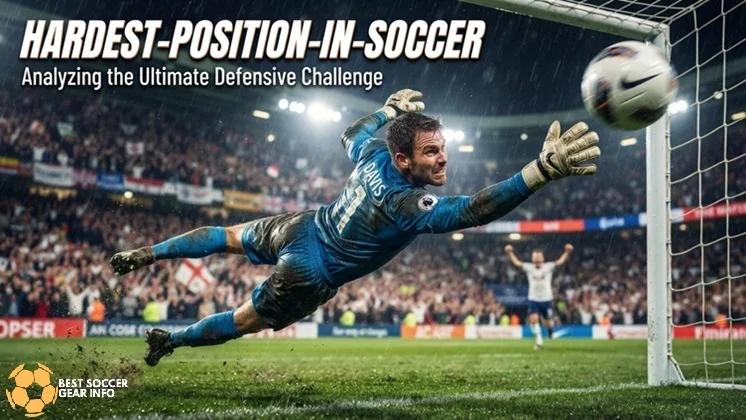
The hardest position in soccer formation depends on what you mean by “hardest.” If you measure the combination of pressure, specialized skills, decision-making, physical demands, and consequences of mistakes, goalkeeper is one of the strongest candidates for the hardest position in soccer.
But goalkeeper is not automatically the hardest for every player. Central midfield, center back, fullback, winger, and striker all have different demands. A midfielder may cover large areas and make constant decisions, while a goalkeeper has fewer continuous movements but faces highly specialized technical and psychological demands.
So the better question is: hardest in what way?
Which Is the Hardest Position in Soccer?
There is no official FIFA ranking that declares one soccer position the hardest. The answer changes depending on the criteria being used.
| Position | What makes it difficult? | Main challenge |
| Goalkeeper | Specialized technique, positioning, reactions, pressure | One mistake can immediately lead to a goal |
| Central midfielder | Constant decisions, movement, passing, defending and attacking | Must influence many phases of play |
| Center back | Positioning, reading attacks, duels and communication | Defensive mistakes can create major chances |
| Fullback | Defending plus attacking responsibilities | Must handle both sides of the game |
| Winger | Speed, dribbling, 1v1 situations and final actions | Must consistently beat defenders |
| Striker | Finishing, movement, physical battles and decision-making | Expected to turn chances into goals |
Is goalkeeper the hardest position in soccer?
Goalkeeper can reasonably be considered the hardest position because it requires a highly specialized combination of skills and carries unusual psychological pressure.
A goalkeeper must understand positioning, make quick decisions, handle or parry shots, communicate with defenders, deal with crosses and one-on-one situations, and recover immediately after mistakes.
There is also a major difference between a goalkeeper and an outfield player: the goalkeeper is the only position specifically permitted to use the hands within the penalty area, subject to the Laws of the Game.
However, that does not mean every soccer player would find goalkeeper the hardest position. A player who struggles with aerial balls may find center back harder, while someone who dislikes constant running and decision-making may find midfield more difficult.
Why Is Goalkeeper So Difficult?
Goalkeeping is difficult because the position combines specialized technique, anticipation, positioning, communication and pressure.
1. The margin for error is small
An outfield player can make a mistake and still have teammates behind or around them.
A goalkeeper’s mistake can be much more immediately damaging because the goalkeeper is the final defensive player.
For example, a misplaced pass by a midfielder might be recovered by another teammate. A goalkeeper who misjudges a shot may concede a goal.
2. Goalkeepers need specialized skills
Goalkeepers need skills that outfield players generally do not use to the same extent, including:
- Shot stopping
- Catching and parrying
- Diving
- Positioning
- Handling crosses
- One-on-one defending
- Distribution
- Communication
- Decision-making under pressure
3. Goalkeepers must stay mentally prepared
A goalkeeper can spend significant periods without making a major save and then suddenly have to make an important decision in a fraction of a second.
That combination of waiting, concentration and immediate reaction makes the position mentally demanding.
4. Mistakes are highly visible
When a striker misses a chance, the team may still have another opportunity.
When a goalkeeper makes a major mistake, the result can be immediately visible on the scoreboard.
That does not make goalkeepers more important than every other player in every situation, but it creates a distinctive type of pressure.
Is Midfielder the Hardest Position in Soccer?
Central midfield is one of the strongest candidates if “hardest” means the position requiring the most continuous involvement in the game.
A central midfielder may need to:
- Receive the ball under pressure
- Scan before receiving
- Pass forward
- Keep possession
- Support defenders
- Support attackers
- Cover space
- Press opponents
- Track runners
- Switch play
- Make decisions quickly
A midfielder often operates between defense and attack, which means the player has to understand what is happening on both sides of the ball.
Is central midfield the hardest position?
It can be, depending on the player’s responsibilities.
A central midfielder may have fewer highly specialized actions than a goalkeeper, but the position can require constant movement, awareness and decision-making.
This is particularly true for players in roles such as:
- No. 6 — defensive midfielder
- No. 8 — central or box-to-box midfielder
- No. 10 — attacking midfielder
A No. 6, for example, may have to protect the defense while also helping the team progress the ball.
A No. 8 may contribute defensively, carry the ball, create chances and arrive in attacking areas.
A No. 10 may operate between midfield and defense and be responsible for creating opportunities.
Is Center Back a Hard Position to Play?
Center back is difficult because much of the job depends on positioning, anticipation and decision-making rather than simply winning tackles.
A center back has to read the developing attack and decide when to:
- Hold position
- Step forward
- Track a runner
- Cover a teammate
- Challenge for the ball
- Defend space behind the defensive line
- Move the ball forward
A center back also needs to communicate with nearby defenders and understand the team’s defensive structure.
What makes center back difficult?
The most difficult part is often making the correct decision before the opponent receives the ball.
A defender who reacts too late can be beaten even if they are physically strong.
Is Fullback an Easy Position?
Fullback is sometimes described as an easier position, but that can be misleading.
A modern fullback may need to defend wide areas while also contributing to the attack.
A fullback can be expected to:
- Defend wingers
- Track overlapping runners
- Provide width
- Support attacks
- Deliver crosses
- Join midfield
- Recover quickly after attacking
- Defend one-on-one situations
This makes fullback particularly demanding for players who have to transition repeatedly between attacking and defending.
Is fullback the easiest position in soccer?
There is no universally easiest position.
The difficulty depends heavily on the player’s strengths.
For example, a player with good speed and defensive instincts may find fullback comfortable, while another player may struggle with the repeated attacking and defensive transitions.
Is Striker the Hardest Position in Soccer?
Striker is difficult in a different way.
The striker is often judged heavily by what happens in the final third.
A striker needs to:
- Find space
- Make runs behind defenders
- Receive under pressure
- Combine with teammates
- Shoot accurately
- Finish chances
- Compete physically
- Decide quickly around the penalty area
The difficulty is that scoring opportunities can be limited. A striker may be relatively quiet for much of a match and then have to make the right decision when a chance appears.
Is striker harder than midfielder?
There is no universal answer.
A midfielder generally has more continuous involvement in possession and defensive transitions, while a striker often faces greater pressure to produce goals.
The positions test different abilities.
Is Winger a Hard Position in Soccer?
Winger can be difficult because the position often requires speed, ball control, dribbling and decision-making in isolated situations.
A winger may need to:
- Receive the ball near the sideline.
- Face a defender one-on-one.
- Decide whether to dribble, pass or cut inside.
- Create a crossing or shooting opportunity.
- Recover defensively after losing possession.
Fast players may naturally fit the position, but speed alone is not enough.
A winger also needs close control, timing and the ability to make good decisions at high speed.
Which Soccer Position Is the Most Physically Demanding?
The answer depends on the player’s role and the team’s tactical system.
Midfield positions can be particularly physically demanding because midfielders may repeatedly move between attacking and defensive areas.
Fullbacks and wingers can also have substantial physical demands because they may repeatedly sprint between defensive and attacking situations.
However, “most physically demanding” is different from “hardest overall.”
A position can require less continuous running while still being extremely difficult because of technical or psychological demands.
Which Soccer Position Runs the Least?
Goalkeeper generally has the least continuous running compared with outfield positions, because the goalkeeper primarily operates around the penalty area rather than covering the entire outfield.
But less running does not mean less difficulty.
Goalkeepers may spend long periods positioned relatively close to their goal and then suddenly need explosive movement to make a save, claim a cross or deal with an attacking situation.
This is an important distinction:
Running distance is only one measure of difficulty.
Technical complexity, decision-making, pressure and responsibility also matter.
Which Soccer Position Is the Most Important?
There is no single universally “most important” soccer position.
Soccer is a team sport in which different positions depend on one another.
A goalkeeper prevents goals.
Defenders protect space and stop attacks.
Midfielders connect defense and attack.
Wingers create width and attacking opportunities.
Strikers and other attackers attempt to turn opportunities into goals.
A team can have an outstanding individual player and still struggle if the overall structure does not work.
Therefore, importance and difficulty should not be treated as the same thing.
What Is the Least Important Position in Soccer?
There is no officially least important position.
The idea that one position is “useless” or “unimportant” usually comes from looking at only one part of the game.
For example, a fullback may not score many goals, but their defensive positioning can prevent an opponent from creating chances.
A defensive midfielder may not receive the same attention as a striker, but their positioning can protect the defense and help the team control possession.
Every position exists because the team needs a particular function.
Where Should You Put Your Weakest Player?
If you are coaching a recreational or youth team, there is no universal position where a weak player should always be placed.
Instead, consider the player’s:
- Speed
- Confidence
- Ball control
- Awareness
- Physical ability
- Willingness to defend
- Ability to follow instructions
- Comfort under pressure
For example:
| Player characteristic | Position that may be worth exploring |
| Fast and energetic | Winger, fullback |
| Strong defensive awareness | Center back, defensive midfielder |
| Good passing and vision | Central midfielder |
| Good dribbling and speed | Winger |
| Calm under pressure | Goalkeeper, center back, midfielder |
| Good finishing | Striker |
| Strong communication | Goalkeeper, center back, central midfielder |
These are starting points rather than fixed rules. Players can develop into very different positions as they gain experience.
What Position Is Best for Fast Players?
Winger and fullback are common positions for players whose major strength is speed.
Speed can help a winger beat a defender or attack open space.
A fast fullback can recover defensively and support the attack.
However, speed becomes much more useful when combined with:
- Ball control
- Decision-making
- Timing
- Positioning
- Stamina
- Awareness
A fast player who cannot control the ball or make good decisions may not benefit fully from their speed.
What Position Is Best for Slow Players?
A player does not necessarily need exceptional speed to become effective.
Positions that can reward positioning, awareness, passing and anticipation include:
- Center back
- Defensive midfielder
- Central midfielder
- Some attacking midfield roles
Again, this is not a rule. A player’s technical and tactical qualities matter more than simply labeling them as fast or slow.
Which Position Requires the Most Skill?
There is no objective single answer because different positions require different skill sets.
Goalkeeper requires specialized goalkeeping technique.
Midfield requires a broad combination of technical and tactical skills.
Center back requires defensive positioning and anticipation.
Winger requires ball control, dribbling and attacking decisions.
Striker requires movement and finishing.
So instead of asking which position requires “the most skill,” it is more useful to ask which skills a particular position requires.
Which Position Is the Most Dangerous?
If “dangerous” means the position most exposed to physical contact or injury risk, there is no single position that can be labeled universally the most dangerous.
Different positions experience different types of physical situations.
Defenders may regularly compete for challenges and aerial balls.
Midfielders can experience frequent contact because they operate in congested areas.
Wingers may face repeated one-on-one challenges.
Goalkeepers can face collisions while challenging for the ball.
The type and frequency of contact also vary by age, competition and playing style.
The Hardest Soccer Positions Compared
The following comparison explains why different players may give different answers to the hardest-position question.
| Position | Technical difficulty | Decision-making | Physical demand | Psychological pressure |
| Goalkeeper | Very high | Very high | Explosive rather than constant | Very high |
| Central midfielder | High | Very high | High | High |
| Center back | High | Very high | High | High |
| Fullback | High | High | High | Moderate–high |
| Winger | High | High | High | Moderate–high |
| Striker | High | High | Moderate–high | High |
These categories are descriptive rather than an official ranking. The difficulty of a position changes with the player’s role, formation, coaching system and level of competition.
Why There Is No Universal “Hardest Position”
Consider two players.
Player A is excellent at:
- Reading the game
- Passing
- Positioning
- Staying calm
But Player A struggles with diving and handling shots.
Player B has:
- Excellent reactions
- Strong hands
- Good jumping ability
- Confidence in goal
But Player B struggles with constant movement and passing decisions.
Player A might find goalkeeper extremely difficult, while Player B might find midfield more difficult.
This is why the answer depends partly on player-position fit.
Hardest Position in Soccer by Different Criteria
If you change the definition of “hardest,” the answer can change.
| If you mean… | Position worth considering |
| Specialized technical demands | Goalkeeper |
| Continuous decision-making | Central midfielder |
| Defensive reading and positioning | Center back |
| Attack + defense transitions | Fullback |
| One-on-one attacking | Winger |
| Finishing pressure | Striker |
| Least continuous running | Goalkeeper |
| Broad involvement in play | Central midfielder |
| Specialized psychological pressure | Goalkeeper |
This explains why debates about the hardest soccer position rarely produce one universally accepted answer.
What Is the Second Hardest Position in Soccer?
There is no official second-hardest position.
If goalkeeper is considered the hardest based on specialized responsibility and pressure, central midfield and center back are reasonable positions to discuss next, depending on the criteria being used.
For physical workload, midfield may become more difficult.
For defensive decision-making, center back may become more difficult.
For attacking responsibility, striker or winger may be more difficult.
The answer therefore depends on the definition rather than a fixed ranking.
Does the Formation Change Position Difficulty?
Yes.
The same position can have very different responsibilities depending on the formation.
For example, a fullback in a system that asks the player to stay deep may have different responsibilities from an attacking fullback who regularly moves forward.
A central midfielder in a possession-oriented team may have different responsibilities from a midfielder in a direct counterattacking team.
Formations such as 4-3-3, 4-2-3-1, 3-5-2 and 4-4-2 distribute responsibilities differently.
That means position names alone do not tell you everything about how difficult a player’s job will be.
Soccer Position Numbers and Roles
Traditional soccer numbering can also help explain positions.
| Number | Common role |
| 1 | Goalkeeper |
| 2 | Right back |
| 3 | Left back |
| 4 | Center back or defensive midfielder |
| 5 | Center back |
| 6 | Defensive midfielder or center back |
| 7 | Winger |
| 8 | Central or box-to-box midfielder |
| 9 | Striker |
| 10 | Attacking midfielder |
| 11 | Winger |
These numbers are traditional conventions rather than universal requirements. Modern teams can use numbers differently.
Common Questions About the Hardest Soccer Position
Goalkeeper is one of the strongest candidates because of its specialized skills, pressure and consequences of mistakes. However, there is no official rule saying goalkeeper is the hardest position.
Central midfield and center back are strong candidates, depending on whether you mean continuous decision-making, physical workload or defensive responsibility.
It can be. Central midfielders often have to participate in attacking, defending, possession and transitions, creating a broad and continuous workload.
A defensive midfielder can be extremely demanding because the player has to protect the defense, read danger, receive under pressure and help move the ball forward. Whether it is the hardest position overall depends on the criteria.
Central midfield can be one of the most demanding positions because the player is frequently involved in both defensive and attacking phases.
Striker can be difficult because of finishing pressure and the need to make effective decisions in limited attacking opportunities. It is not universally considered the hardest position.
Yes. Wingers often need speed, close control, dribbling ability, tactical awareness and fast decision-making.
There is no universally easiest position. A position that feels easy to one player may be difficult for another because players have different strengths and weaknesses.
Goalkeeper generally covers the least continuous distance because the position is concentrated around the goal rather than across the outfield.
Midfield can be particularly physically demanding because players may repeatedly transition between attacking and defending. Fullbacks and wingers can also face substantial physical demands.
There is no officially least important position. Every position contributes a different function to the team’s structure.
There is no universally most important position. A successful team depends on the interaction between its goalkeeper, defenders, midfielders and attackers.
Choose a position based on the player’s strengths, confidence, understanding of the game and development needs rather than simply putting the weakest player in one particular position.
Final Answer: What Is the Hardest Position in Soccer?
If you need one answer, goalkeeper is a strong candidate for the hardest position in soccer because it combines specialized technical skills, rapid reactions, positioning, communication and exceptional psychological pressure.
But if you define “hardest” as constant involvement and decision-making, central midfield may be the better answer.
If you define it as defensive reading and positioning, center back becomes a strong candidate.
If you define it as attacking pressure and finishing, striker may be the most difficult.
So the most accurate answer is:
There is no universally hardest soccer position. Goalkeeper is one of the strongest candidates overall, while central midfield, center back, fullback, winger and striker can each be the hardest depending on the specific demands being measured.
The hardest position for an individual player is ultimately the one whose required skills are furthest from that player’s strengths.
Related Soccer Position Topics
For a broader understanding of the subject, explore the site’s soccer positions hub for explanations of player roles, position numbers, formations, defensive positions, midfield roles, forwards and how responsibilities change across different formations.
