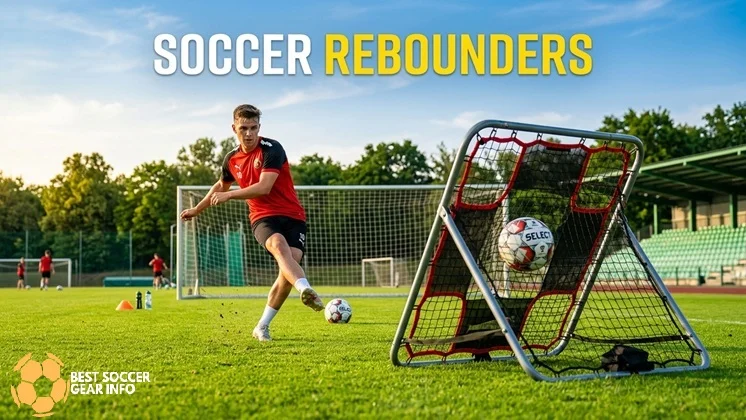
A soccer rebounder is a training frame with a net or rebound surface that sends a soccer ball back toward the player after it is kicked or thrown into it. Rebounders are used for solo practice, partner drills, first-touch training, passing, shooting, ball control, and reaction work.
They come in different sizes and designs, including portable practice rebounders, angled rebound nets, large rebounder walls, and goal-style rebounders. The right choice depends mainly on what skill you want to practice, where you will use it, the available space, and how durable the frame and net need to be.
What Is a Soccer Rebounder?
A soccer rebounder is a piece of soccer training equipment designed to return the ball to the player.
Unlike a conventional soccer goal, which is primarily designed to stop a shot in a net, a rebounder is designed to return the ball. The player can then receive it, control it, pass it again, or use the returning ball for another technique.
A typical rebounder consists of:
- A frame
- A rebound net or rebound surface
- Net attachment points
- A supporting base or legs
- Sometimes adjustable angles
- Ground anchors or stabilizing components
The rebound behavior depends on the net tension, frame design, angle, ball speed, and point of contact.
How Does a Soccer Rebounder Work?
The basic process is simple:
Player → Soccer ball → Rebound surface → Ball returns → Player controls or strikes it again
When the ball hits the tensioned net, some of its kinetic energy is absorbed by the net and frame while the remaining energy sends the ball back toward the player.
A rebounder’s angle can also change the direction of the returning ball. A nearly vertical rebound surface can return the ball relatively directly, while an angled surface can send it upward or downward.
This makes one rebounder useful for several types of training.
What Can You Practice With a Soccer Rebounder?
A rebounder can support many individual and partner drills.
Passing
Kick the ball into the rebounder and receive the return. This can help you repeatedly practice:
- One-touch passing
- Two-touch passing
- Inside-foot passes
- Short passes
- Receiving under pressure-like repetition
First Touch
A rebounder is particularly useful when working on first touch because the ball can return repeatedly without another player having to pass it.
You can vary the first touch by receiving with:
- Inside of the foot
- Outside of the foot
- Instep
- Sole
- Thigh
- Chest
Shooting
Larger or stronger rebounders can be used for shooting practice, provided the rebounder is designed to handle the force.
After shooting, the returning ball can create another repetition without needing someone to retrieve and pass the ball every time.
Ball Control
A rebounder can return balls at different speeds and angles, allowing players to practice controlling unpredictable returns.
Reaction Training
Changing the distance, angle, and speed of the pass can make the returning ball less predictable. This can be useful for reaction and decision-making drills.
Heading and Aerial Control
Some rebounders can also be used for controlled aerial-ball exercises. The appropriate rebounder depends on its height, construction, and intended use.
Types of Soccer Rebounders
Not all soccer rebounders are designed for the same purpose.
| Type | Typical use | Main characteristic |
| Flat rebounder | Passing and first touch | Relatively predictable return |
| Angled rebounder | Ball control and aerial work | Changes return trajectory |
| Adjustable rebounder | Multiple drills | Angle can be changed |
| Large rebounder wall | Shooting and passing | Larger target area |
| Goal-style rebounder | General soccer training | Combines goal-like shape with rebound function |
| Portable rebounder | Home and travel use | Designed for easier setup and movement |
| Indoor rebounder | Indoor practice | Smaller footprint and controlled use |
| Multi-surface rebounder | Advanced training | Different sections can produce different returns |
Soccer Rebounder vs. Rebounder Wall
The terms soccer rebounder, soccer rebounder wall, and soccer wall rebounder can describe similar training equipment, but the design can differ.
A traditional rebounder generally uses a tensioned net attached to a frame. A rebounder wall may provide a larger or more rigid rebound surface.
A net rebounder is usually more portable, while a wall-style training surface may provide a more consistent return depending on its construction.
Soccer Rebounder Net: Why It Matters
The rebounder net is one of the most important components because it directly interacts with the ball.
When comparing rebounder nets, consider:
- Net strength
- Mesh construction
- Attachment system
- Tension
- Resistance to repeated impacts
- Weather exposure if used outdoors
- Ease of replacement
A weak or poorly attached net can affect the rebound and may require replacement sooner.
The frame is equally important because a strong net cannot compensate for an unstable or poorly constructed frame.
Soccer Rebounder Size
There is no single standard size for every soccer rebounder.
Small rebounders can be convenient for close-control and passing drills, while larger rebounders provide a bigger target for shooting and longer-range passing.
The useful size depends on the training objective.
| Training objective | Useful design consideration |
| Close passing | Compact rebound surface |
| First-touch work | Medium target area |
| Shooting | Larger and stronger rebounder |
| Youth training | Size appropriate to the player’s space and ability |
| Indoor practice | Compact footprint |
| Multiple players | Larger rebound surface |
| Travel | Lightweight, portable construction |
Rather than choosing solely by dimensions, match the rebounder size to the ball distance, training space, and drill.
Are Soccer Rebounders Worth It?
For players who regularly practice alone, a soccer rebounder can provide a practical way to increase the number of ball contacts in a training session.
Its main advantage is repetition. Instead of waiting for another player to return the ball, the rebounder can continuously send it back.
However, a rebounder does not replace:
- Team training
- Live opponents
- Match situations
- Tactical practice
- Real defensive pressure
- Small-sided games
It is best viewed as a training tool, not a substitute for complete soccer development.
Do Soccer Rebounders Work?
Yes, a properly selected and positioned rebounder can return the soccer ball repeatedly for individual training.
How useful it is depends on the rebounder’s construction and how you use it. A rebounder positioned incorrectly or placed on an unstable surface may produce inconsistent returns.
For better results:
- Place it on a stable surface.
- Secure it when necessary.
- Stand at an appropriate distance.
- Start with controlled passes.
- Increase power as your control improves.
- Change angles and distances to create different returns.
- Practice both feet.
Soccer Rebounders for Solo Training
Solo training is one of the main reasons players buy rebounders.
A player can create a simple repetition:
Pass → receive → control → pass → receive → control
More advanced drills can add:
Pass → first touch → turn → sprint → receive → finish
The exact drill should match the player’s skill level rather than simply maximizing speed or power.
Soccer Rebounders for Kids
A rebounder can be useful for young players because it allows them to get repeated touches without requiring a training partner.
For children, consider:
- Appropriate rebounder size
- Stable construction
- Easy setup
- Safe surrounding space
- The child’s height and ability
- Whether the rebound surface can handle the intended ball
A smaller rebounder may be easier for a young player to use, while a larger model can remain useful as the player develops.
Indoor Soccer Rebounders
Indoor rebounders can be useful where outdoor space is unavailable.
Before using one indoors, check:
- Ceiling height
- Available floor area
- Nearby windows and fragile objects
- Wall and floor protection
- Rebound distance
- Noise considerations
A compact rebounder is generally easier to manage in a garage, gym, basement, or other controlled space than a large outdoor model.
Portable Soccer Rebounders
Portable rebounders are designed to be moved between locations.
They can be useful for:
- Backyard practice
- Training fields
- Travel
- Camps
- Team practice
- Home training
Portability usually involves some compromise between weight, stability, size, and durability. A very lightweight rebounder may be easier to carry but may require better anchoring outdoors.
What Makes a Good Soccer Rebounder?
There is no single feature that makes every rebounder suitable for every player.
Look at these attributes together:
1. Frame Construction
The frame needs enough rigidity to remain stable when the ball hits the net repeatedly.
2. Net Quality
The net should be appropriate for the force and frequency of use.
3. Rebound Consistency
A useful rebounder should provide reasonably predictable returns for the drills it is designed to perform.
4. Stability
Outdoor rebounders may need stakes, anchors, weighted bases, or another method of preventing movement.
5. Angle Adjustment
An adjustable rebounder can provide more training possibilities than a fixed-angle design.
6. Portability
If you regularly transport the rebounder, weight and folding or assembly design become more important.
7. Size
Choose the target area according to your drills and available space.
8. Durability
Frequent shooting places more stress on the frame and net than gentle passing.
How to Choose a Soccer Rebounder
Start with the training goal, not the brand.
For passing and first touch
Look for a rebounder that provides a consistent return and is easy to position.
For shooting
Prioritize a larger, sturdy construction capable of handling harder shots.
For children
Consider an appropriately sized rebounder that is stable and simple to use.
For indoor use
Prioritize compact dimensions and controlled rebound characteristics.
For outdoor use
Pay particular attention to stability, anchoring, weather exposure, and frame durability.
For multiple training purposes
An adjustable or multi-function rebounder may provide more flexibility.
Soccer Rebounder Price: What Determines the Cost?
Soccer rebounder prices vary substantially because rebounders differ in size, materials, construction, portability, and adjustment mechanisms.
Instead of assuming that the most expensive rebounder is automatically better, compare:
- Frame materials
- Net quality
- Dimensions
- Adjustability
- Stability system
- Portability
- Replacement-part availability
- Intended training intensity
A basic rebounder may be sufficient for occasional passing practice, while frequent shooting and intensive training can justify a more robust construction.
Cheap Soccer Rebounders: What to Check
A low price does not necessarily make a rebounder unsuitable, but inspect the specifications carefully.
Before buying a cheaper model, check:
- Frame stability
- Net attachment
- Available dimensions
- Customer reviews
- Assembly requirements
- Ground anchoring
- Warranty
- Replacement net availability
The cheapest option can become less economical if the net or frame fails quickly.
Buying Soccer Rebounders Online
When shopping online, don’t rely only on product photos.
Look for the actual:
- Dimensions
- Weight
- Materials
- Net type
- Adjustment range
- Assembly method
- Included accessories
- Intended age or training use
Search results may contain everything from small youth rebounders to large professional-style training equipment, so specifications matter more than the product name alone.
Soccer Rebounders for Sale
Soccer rebounders are commonly sold through sporting-goods retailers and online marketplaces.
When comparing models, create a simple checklist:
| Feature | Why check it? |
| Price | Fits your budget |
| Size | Determines target area |
| Frame | Affects stability and durability |
| Net | Controls rebound characteristics |
| Angle | Determines return trajectory |
| Anchoring | Helps prevent movement |
| Portability | Important for travel/storage |
| Replacement parts | Useful for long-term ownership |
Common Soccer Rebounder Mistakes
Using the wrong rebounder for the drill
A small passing rebounder may not be suitable for repeated powerful shooting.
Not securing the rebounder
Outdoor use can require anchoring, especially when the ball is striking the frame repeatedly.
Standing too close
Very short distances can make some drills unnecessarily difficult because the player has little time to react.
Always using the same angle
Changing the angle can create different ball trajectories and make training more varied.
Practicing only one foot
A rebounder makes it easy to repeat a drill, but repetition should include both feet when appropriate.
Treating rebounder training as complete soccer training
Rebounders are excellent for repetition, but they cannot reproduce every aspect of playing against real opponents.
Frequently Asked Questions
A soccer rebounder is a training device with a net or rebound surface that returns a soccer ball after it is kicked or thrown into it.
Yes. Their main benefit for solo players is the ability to repeatedly return the ball without requiring another person to pass it.
Some do. Larger, sturdier rebounders are generally more appropriate for powerful shooting than small passing rebounders.
It is the tensioned net or mesh surface that receives the ball and sends it back toward the player.
They can be worthwhile for players who want convenient, repetitive practice, particularly when they train alone.
Yes, if the rebounder is suitable for indoor use and there is sufficient safe space around it.
They can be useful for children practicing passing, receiving, ball control, and other basic skills, provided the equipment and training area are appropriate.
A soccer rebounder wall is a rebound training surface designed to return the ball to the player. Some use tensioned netting, while others use more rigid surfaces.
Focus on the frame, net, stability, size, rebound consistency, angle adjustment, portability, and intended training purpose.
The price varies by size, construction, features, and intended use. Compare the specifications and durability rather than choosing solely by price.
Not completely. A goal is designed primarily for finishing and scoring, while a rebounder is designed to return the ball for repeated training.
Final Takeaway
A soccer rebounder is one of the more versatile pieces of individual soccer training equipment because it turns a single player and a soccer ball into a repeatable practice setup.
The most important decision is not simply finding the biggest or most expensive model. Choose according to what you want to practice: passing and first touch, shooting, ball control, aerial work, indoor training, youth practice, or general solo training. A suitable rebounder should provide the right combination of rebound behavior, stability, size, durability, and portability for your particular training environment